M&A in Banking
Turn transaction strategy into a stronger combined institution.
Table of Contents
01
Why M&A is Accelerating in Banking
As margins tighten and the cost of transformation rises, consolidation can provide access to shared resources, broader capabilities, and a stronger competitive position.
Every week seems to bring another headline: two banks combining forces, a credit union absorbing a smaller peer, a name you knew disappearing into a larger brand. This isn't noise; it's a signal. The institutions sitting on the sidelines are watching their competitors make a calculated bet on survival, and the pressures driving that bet aren't going away. If you're wondering whether M&A is a passing trend or the new normal, the answer is already playing out in the numbers.
Strategic Drivers of M&A
Four forces are converging to make merger and acquisition activity a strategic imperative rather than a last resort:
- Technology demands. The cost of building and maintaining competitive digital banking, fraud prevention, and core infrastructure keeps climbing, and scale is increasingly the only way to absorb it.
- Regulatory changes. Compliance requirements continue to grow more complex, favoring institutions with the resources to manage them efficiently.
- Shifting consumer expectations. Customers now measure their bank or credit union against fintechs and national players, raising the bar on experience and convenience.
- Increased competition. Nonbank entrants and larger regional players are squeezing margins and market share for smaller institutions.
Analysts note this wave of consolidation is "no longer driven primarily by distress or cost reduction." In fact, a merger or acquisition may be one path to building the scale, capabilities, or market position needed for the future.
One of the primary strategic drivers behind the surge in M&A activity is the pursuit of scale. Banks and credit unions of every size are under mounting pressure to operate more efficiently, attract and retain top talent, invest in modern technology, and expand their market reach.
Before pursuing a transaction, institutions should define the outcomes they are trying to achieve and the principles that will guide their decisions. A clear M&A philosophy helps leaders evaluate whether a potential partner, transaction structure, and integration path support the institution's long-term strategy.
The Consolidation Environment Has Changed
The regulatory environment influencing consolidation has shifted has shifted materially. For community financial institutions, this change has two important implications:
First, larger regional banks, encouraged by a more favorable regulatory environment, are reassessing their growth strategies, and community institutions may increasingly become acquisition targets. Second, credit unions continue to pursue bank acquisitions and other combinations as part of their own growth strategies, introducing another source of competition for potential sellers.
Together, these dynamics are expanding the field of potential buyers and changing how institutions should evaluate their strategic options. Institutions with a clear M&A philosophy are better positioned to assess those options against their long-term strategy rather than react to market pressure.
Finding the Right M&A Partner
M&A pressure and buyer capacity are not evenly distributed across markets. In many states, institutions under pressure to sell now outnumber qualified buyers, creating "buyer deserts" where local M&A options are scarce.
Geography is loosening as a constraint in response. Buyers in tight local markets are increasingly looking across state lines toward regions where seller pressure is building.
Institutions facing a limited local buyer pool have an opportunity to broaden their geographic search and assess a wider range of potential partners. Out-of-state acquirers often bring advantages local buyers can't match: greater balance-sheet capacity, experience integrating multiple organizations, and added competitive tension in bidding.
For buyers, the calculus is reversed. Institutions in buyer-rich, seller-light markets must expand geographically or risk their acquisition pipelines drying up. Those that build out-of-state M&A capabilities now stand to gain first-mover advantage as sellers accumulate and local options run out.
An effective M&A strategy can no longer assume that the right partner is nearby. It should assess market conditions, potential partners, and integration implications both within and beyond an institution's current footprint. Read our report to see where M&A pressure is rising, and where the next opportunities may emerge.
The Need for M&A Expertise
Mergers and acquisitions can accelerate growth, expand market reach, and strengthen long-term competitiveness. However, financial institutions often underestimate the work required to translate a promising transaction into a successful combination.
Technology and data decisions, cultural alignment, operational processes, regulatory requirements, and customer or member impact must all be managed carefully. A single misstep can quickly turn a strategic opportunity into operational disruption. Success requires disciplined planning, specialized expertise across the organization, and coordinated execution before, during, and well after the deal closes from early strategy through Legal Day 1, conversion, and long-term value realization.
02
The M&A Lifecycle for Banks and Credit Unions
Every bank and credit union merger follows a similar lifecycle, although the timing, complexity, and regulatory path vary by transaction. Each phase builds on the decisions made before it, making continuity and alignment essential.
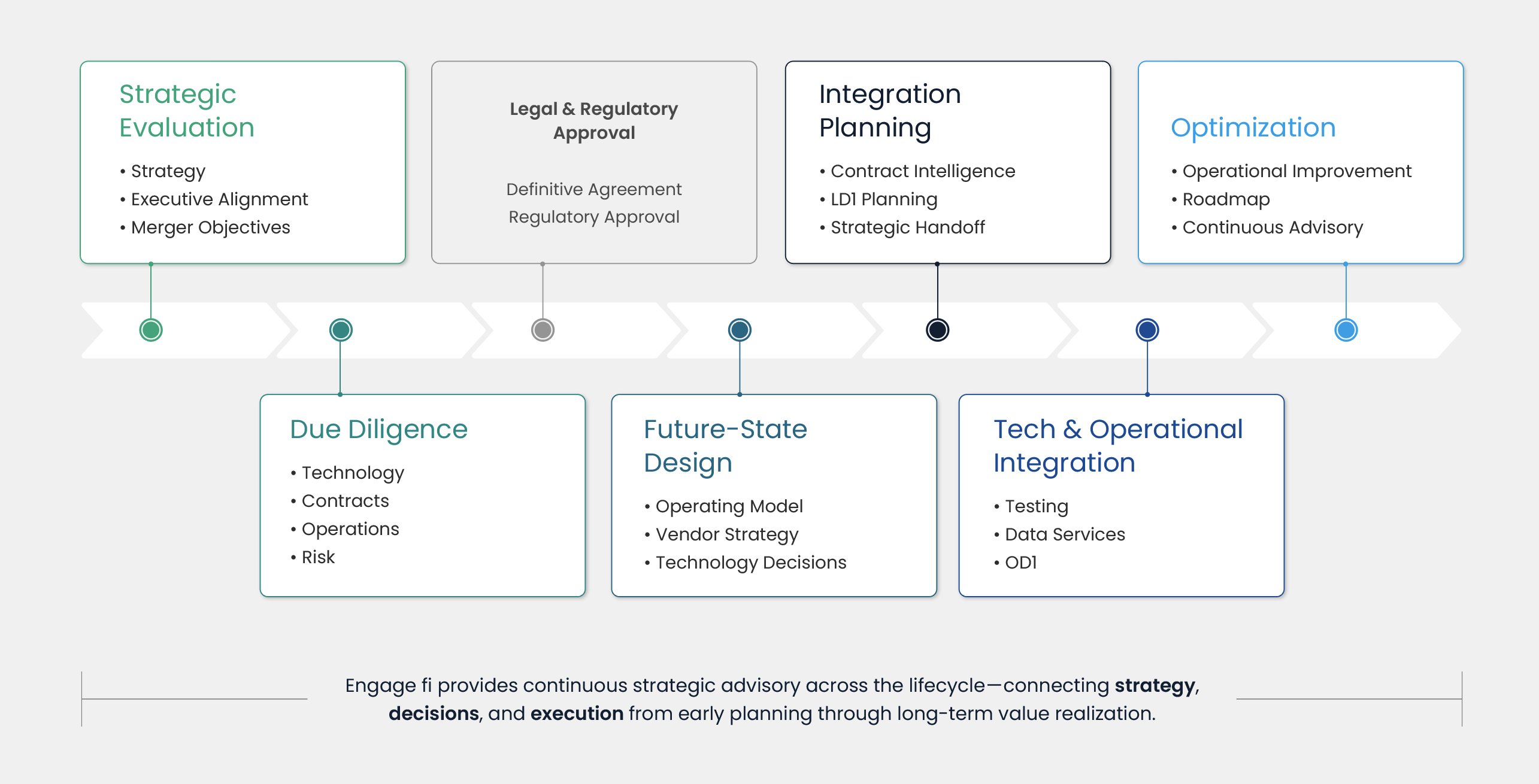
Investment bankers, legal counsel, accountants, and regulators each play important roles in structuring, evaluating, and approving the transaction itself. Engage fi complements them by guiding the business, data, organizational, and operational decisions that turn strategy into execution.
Rather than approaching each phase as a separate project, Engage fi provides a continuous consulting thread that helps preserve strategic intent from early planning through future-state design, integration, conversion, and long-term value realization, bringing the right expertise from across our service verticals as the institution moves through each phase.
03
Pre-Deal Readiness: Merger Synergies & Organizational Preparedness
A successful merger begins long before the agreement is signed. Financial institutions must define their merger philosophy, assess cultural compatibility, organizational readiness, leadership structure, and potential synergies early enough to shape the transaction, not after critical decisions have already been made.
Defining the Purpose of the Deal
Before a merger or acquisition can begin, leaders must understand what distinguishes their institution, define the future institution they want to build, and answer a fundamental question: why are we doing this?
Mergers and acquisitions should be grounded in strategy and on the needs of customers or members, rather than on growth for its own sake. Leadership must first define what "better" means for employees, customers or members, and the communities the combined institution will serve, as well as the priorities that will guide trade-offs along the way. That vision should then guide partner selection, integration priorities, and the metrics by which success is measured.
A clear pre-deal plan [with defined objectives, roles, timing, decision right, and decision points] creates alignment and prevents the transaction from drifting away from its intended purpose.
Assessing Culture and Organizational Fit
Financial compatibility may make a transaction possible, but cultural and organizational compatibility often determine whether it succeeds. Before signing, institutions should evaluate how well their leadership styles, decision-making processes, employee expectations, service philosophies, and community commitments align.
Successful integrations bring together the strongest elements of both organizations. They blend cultures thoughtfully rather than allowing one institution to simply bulldoze the other. Significant differences do not necessarily mean a deal should be abandoned, but leaders must identify them early and determine whether they can be reconciled or require deliberate integration planning.
Employee anxiety is natural during a merger. Clear, honest communication helps reduce uncertainty and build trust. When employees understand the institution’s vision, how decisions will be made, and what the combination could mean for their roles, they are more likely to remain engaged throughout the transition.
Building a Merger Synergy Strategy
Merger synergy planning is distinct from deal valuation. Valuation helps determine the financial terms of a transaction, while a synergy strategy identifies how the combined institution will create value through and after the deal closes.
That value may come from more than expense reductions. Potential synergies can include improved technology, stronger vendor contracts, streamlined operations, expanded products and services, boarder market reach, new revenue opportunities, and access to specialized talent.
-1.png?width=4000&height=2000&name=Section%203%20Merger%20Synergies%20(2)-1.png)
Leadership Planning and Organizational Structure
Leadership and organizational decisions should begin before close. Delaying difficult conversations about executive roles, reporting relationships, governance, decision-making authority, and departmental structure can create uncertainty at the moment employees need clarity most.
Leaders must determine where responsibilities will reside and how talent from both organizations will be evaluated and retained, including the critical knowledge and capabilities the combined institution needs to carry forward.
As the institution goes through the merger or acquisition, leadership must be visible, approachable, and transparent with the board, staff, and customers or members. True success isn’t defined solely by the size of a balance sheet, but by trust, membership, and community impact.
Why Merger Synergy Targets Are Missed
Synergy targets are often missed because financial institutions treat them as assumptions in a financial model rather than outcomes that require active management, and accountable ownership. Common causes include unclear ownership, unrealistic timelines, delayed leadership decisions, cultural resistance, underestimated integration costs, and inadequate coordination across people, technology, data, and operations.
By preparing before the deal is signed, institutions can identify risks earlier, establish shared expectations, and enter integration with a clearer path to realizing the transaction’s intended value. This early work establishes the direction that future-state design, technology, data, operational, and conversion planning must carry forward.
04
How Engage fi Works Alongside Your M&A Advisors
M&A requires a coordinated team of specialists. Engage fi works alongside your internal team and specialized advisors as an extension of the team responsible for translating the transaction into an executable future state.
The Role of Other M&A Advisors
- Legal Counsel: Determine whether the deal is structured appropriately and contractually protected. Areas of responsibility include deal structure, negotiation, purchase or merger agreements, legal due diligence, governance requirements, contractual obligations, liability exposure, intellectual property, drafting the merger application and related regulatory filings, advising on legal aspects of regulatory approval, and closing documentation.
- Financial Advisors: Determine what the deal is worth and whether it is financially viable. Areas of responsibility include deal valuation, financial modeling, pricing, balance sheet analysis, tax considerations, capital implications, earnings impact, credit and asset quality review, and overall financial feasibility.
- Compliance & Regulatory Advisors: Determine whether the transaction and combined institution will satisfy regulatory obligations. Areas of responsibility include regulatory requirements, required filings and approvals, consumer-protection obligations, fair lending, BSA/AML, sanctions, privacy, licensing, policy alignment, and compliance-risk assessment.
This division of responsibility builds trust and improves execution. Engage fi helps financial institutions define their merger philosophy, make connected business, technology, data, organizational, and operational decisions, and carry that direction into due diligence, merger application planning, Legal Day 1, conversion readiness, and long-term value realization.
Engage fi does not provide legal, branding, or name change advice, transaction valuation, tax advice, or regulatory compliance advice.
05
Post-Approval Execution: Technology, Contracts, and Products
Once a merger or acquisition is approved, the focus shifts from planning the transaction to carrying the institution's strategic decisions forward and preparing the combined institution for execution.
While many of these decisions begin during diligence and application planning, technology and core platform decisions, vendor contract negotiations, and product pricing harmonization must be coordinated carefully to control costs, reduce risk, and create a consistent consumer or member experience.
Technology & Core Strategy
Technology is one of the most complex, costly, and consequential components of any integration. The combined institution must determine which core system, digital banking platform, payments solutions, and supporting technologies will best serve its future operating model and merger priorities—not simply default to one institution’s existing platforms.
Engage fi brings experience across financial technology platforms, vendor ecosystems, and integration planning to help evaluate capabilities, costs, scalability, conversion requirements, data readiness, and integration risks. A comprehensive assessment can identify redundant systems, uncover capability gaps, and establish a technology roadmap that supports the combined institution’s long-term strategy and provides a sequenced path to Legal Day 1 and conversion.
These decisions should account for more than conversion timelines and immediate expenses. The institution must also consider how its technology choices will affect employees, customers or members, operational efficiency, future growth, and the overall integration experience.
Contract Negotiation
A merger or acquisition can affect nearly every vendor agreement held by both institutions. Core contracts, digital banking agreements, card-network relationships, payments contracts, and other third-party arrangements may contain termination provisions, conversion fees, change-of-control clauses, minimum commitments, or pricing terms triggered by the transaction.
Engage fi tracks and manages deliverables across the combined contract portfolio, helping identify overlapping services, unnecessary expenses, and contractual risks. We can also support negotiations for select agreements within the portfolio. For the contracts we negotiate, we use proprietary tools and technology to help institutions maximize savings, reduce expenses, and improve overall value. Our approach extends beyond cost reduction to address business terms that strengthen the institution’s position, support operational goals, and mitigate risk.
Product & Pricing Harmonization
The merger of two organizations with two different sets of products and services requires a full assessment of the new unified product suite. An experienced consultant can help evaluate the existing portfolios and help develop a unified product suite aligned with the combined institution’s brand and strategic direction.
06
Data and Systems Migration: What to Expect
System and data migration are often the point at which the merger becomes most visible to customers or members. Poor data quality, disconnected systems, or rushed timelines can undermine trust and make the integration more complex and costly.
The technical conversion is typically executed by core, digital, payments, and other technology providers, working closely with the institution’s operational and business teams. Internal IT teams play an important role where interfaces, infrastructure, access, cybersecurity, and other technology dependencies are affected.
Engage fi helps institutions prepare for and manage the conversion, connecting the decisions made during integration planning to the detailed work required for a successful transition. Our Conversion Consultants coordinate the conversion program; manage dependencies, risks, and escalation; coordinate with technology providers and other implementation partners; and support testing, mock conversions, cutover planning and execution, Operational Day One, and post-conversion stabilization.
What the Migration Phase Includes
A conversion program may include data cleanup and cleansing, field mapping, interface design, file validation, product configuration, test cycles, reconciliation, user acceptance testing, employee training, customer or member communications, cutover planning, contingency procedures, and post-conversion support. The exact scope depends on the number of systems, the complexity of the product portfolio, and how much standardization occurs before cutover.
Engage fi’s Data Services team can support data readiness activities such as data assessment, cleanup, matching, and validation. Conversion Consultants then incorporate those activities into the broader conversion plan and coordinate the testing, readiness, cutover, and stabilization activities required to move the organization into the future state.
Protecting the Customer or Member Experience
Even small changes can confuse users. A relocated button, a new login process, different transaction descriptions, revised cutoff times, or unfamiliar alerts may generate calls and erode confidence. Institutions should map the end-to-end experience and anticipate where customers or members will notice change.
Communication should be timely, plain-language, and specific. Employees need enough training and reference material to explain what is changing and resolve common issues. Contact centers and branches should have escalation paths, temporary staffing plans, and visibility into known issues. Digital support content should be updated before customers encounter the new experience.
07
Real World Mergers and Acquisitions
For financial institutions, mergers and acquisitions continue to serve as a strategic lever for growth, enabling expanded market presence, diversified balance sheets, and enhanced delivery channels for members and customers.
A Credit Union’s Transformation Story
Prior to merging with Catholic Vantage Financial, Christian Financial Credit Union served nearly 56,000 members and managed approximately $950 million in assets. Catholic Vantage Financial, a smaller but like‑minded credit union in the metro Detroit market, contributed an additional $120 million in assets, further strengthening the combined institution’s capital base and lending capacity.
The merger decision was anchored in strong cultural and mission alignment, with both organizations deeply rooted in and serving the same faith-based community.
The transaction was structured to drive greater economies of scale and operational efficiency, broaden the institution’s footprint across metro Detroit, and elevate the member experience through expanded products, services, and delivery channels.
Following the merger, the combined organization grew to nearly 62,000 members and more than $1.1B in assets. The credit union also secured approval to expand its field of membership, enabling it to serve individuals across the entire state of Michigan.
The integration included a successful core conversion, the migration of 10,000 digital banking users, and coordination across 78 vendors and ancillary systems. Membership increased by 12%, reflecting the strength of the combined organization. The conversion weekend was completed ahead of schedule, resulting in minimal member downtime and no disruptions to member accounts, including no account number changes or debit card or check reissuance.
As a result of the merger, the credit union is positioned to deliver an enhanced member experience through expanded service capabilities, reduced fees, and improved product offerings.
Read more about their merger here.
08
Frequently Asked Questions About Bank & Credit Union M&A
Expert answers to the questions we hear most often from bank and credit union leadership teams.
How long does bank merger integration take?
Most bank and credit union mergers take 18 to 30 months from a signed letter of intent (LOI) to a fully integrated institution. The work moves through three overlapping stages:
- LOI to legal close: 6 to 9 months. Bank deals often close faster. Credit union mergers frequently run longer because they require NCUA approval and a member vote.
- Legal close to core conversion: 6 to 12 months. Some smaller transactions convert at legal close, but most schedule conversion separately.
- Conversion to full integration: 6 to 12 months. Products, pricing, policies, and vendor relationships settle into a single operating model.
The core provider's conversion calendar is often the tightest constraint on the schedule. Conversion windows book months in advance, so institutions that plan early keep more control over their timeline.
What happens to core contracts after a merger?
Most mergers end with one surviving core platform and one surviving vendor agreement. The institution leaving its core typically faces deconversion fees and, in many cases, liquidated damages calculated on the contract's remaining term. Change-of-control clauses can also trigger obligations as soon as the deal closes.
Core providers often offer to absorb termination fees into a new contract. That offer is rarely free. Providers usually recover the cost through pricing over the life of the new agreement.
Review your own contracts before the LOI and both institutions' contracts during due diligence. Focus on term and renewal dates, deconversion fees, change-of-control provisions, and current pricing. Your negotiating leverage with core providers is greatest before they know a transaction is coming.
Do we need a separate M&A advisor from our attorney?
In most transactions, yes. A merger typically involves three distinct advisory roles:
- Legal counsel structures the transaction, drafts the agreements, and manages regulatory filings and approvals.
- A financial advisor handles valuation, deal terms, and financial modeling. In credit union mergers, where there is usually no purchase price, this role centers on financial analysis and merger accounting.
- An integration advisor manages the operational side: technology strategy, vendor contracts, integration planning, product harmonization, and organizational readiness.
Smaller transactions sometimes combine roles, but attorneys and financial advisors rarely take on the operational work. That gap is where most integration risk lives.
When should we begin planning our merger and who should be involved internally?
Planning should begin before the LOI is signed. At this stage, keep the team small to protect confidentiality: executive leadership, the board, and trusted outside advisors. Early work should include a review of your own vendor contracts and an honest look at the conversion constraints that will shape your timeline.
After the LOI, expand planning to include technology, operations, lending, HR, finance, compliance, and marketing and communications. Appoint a dedicated integration leader with the authority to make decisions and resolve conflicts across workstreams.
Starting early preserves scheduling flexibility and gives leadership time to make decisions deliberately rather than under deadline pressure.
Which merger decisions must be finalized before announcing the merger or acquisition?
Before announcing a bank or credit union merger, leadership should align on:
- Executive leadership, CEO succession, and board composition
- Name and brand strategy
- Headquarters and branch commitments
- Employee communication and retention plans
- Target dates for legal close and system conversion
- Immediate impact on customers or members
- For credit unions, the member vote plan and charter decisions
These are the decisions most likely to stall a transaction if they remain open. Technology decisions can still be in progress at announcement, but leadership should have a defined process and timeline for making them.
What is the difference between legal close, operational integration, and system conversion?
These are three distinct phases of the merger integration process:
- Legal close completes the transaction and combines the institutions into a single legal entity.
- Operational integration aligns policies, products, pricing, vendors, staffing, and business processes.
- System conversion (often called core conversion) moves customer or member accounts, data, and technology onto a single operating platform.
These phases overlap rather than run in sequence. Operational integration begins before legal close and continues well after conversion. Many product and policy decisions must be settled before conversion so accounts can be mapped correctly to the surviving platform.
How do we coordinate a system conversion along with operational and organizational changes?
Successful merger integration runs on one coordinated plan instead of separate technology, HR, and communications projects. Five practices reduce risk:
- Build an integrated master schedule that ties technology milestones to staffing, training, and communication dates.
- Finalize employee roles before conversion so staff train on the systems and processes they will actually use.
- Freeze nonessential projects and scope changes in the months leading up to conversion.
- Run mock conversions to test data mapping and surface issues before go-live.
- Keep a centralized decision log so every workstream works from the same answers.
Coordinated workstreams lower conversion risk and protect both the employee and the customer or member experience.
When is the M&A process truly complete?
A merger is complete when the combined institution operates as one organization, with unified systems, products, pricing, policies, vendor relationships, and culture. For most institutions, that point arrives 6 to 12 months after core conversion, when planned synergies show up in financial performance and day-to-day operations.
Culture is the hardest piece to measure. Useful signals include employee retention, engagement survey trends, and the moment staff stop describing their work in terms of "legacy" institutions.
09
Turn Your M&A Strategy Into a Successful Integration
Wherever your institution is in the M&A lifecycle, Engage fi provides specialized expertise needed to move forward with clarity and confidence.
Our team brings seasoned C-suite leadership and decades of financial services experience to every engagement. We help banks and credit unions make connected decisions, anticipate obstacles, coordinate complex workstreams, and maintain momentum from letter of intent through full integration. By combining specialized talent, proven methodologies, proprietary tools, and industry best practices, we help institutions reduce risk, realize the value the merger was meant to create, and build a stronger combined organization.
Preparing for a Potential Deal?
Engage fi helps leadership teams assess organizational readiness, evaluate cultural and operational fit, define potential synergies, and establish a clear vision for the combined institution, before commitments are made.
Approved a deal and preparing for integration?
Once a merger or acquisition is approved, Engage fi helps turn the transaction strategy into an actionable integration plan and carry it through execution. Our team can assess technology platforms, renegotiate in-scope vendor agreements, align product and pricing strategies, and coordinate the work streams required for a successful transition.
Guiding Financial Insitutitions Toward a Stronger Future
Position your bank or credit union to thrive as a modern, efficient, and sustainable organization. Focus on supporting your customers and members today while adapting to meet future challenges.
