


Payments have officially left the back office and crashed the C‑suite party - now they’re one of the sharpest ways banks and credit unions compete, grow, and keep customers from wandering off. As digital adoption sprints ahead and “right now” becomes the only acceptable SLA, the pressure is on to make every payment experience feel instant, effortless, and invisible. Yet, despite all the buzz, digital payment maturity is still all over the map in our industry. So where does the playing field stand today - and where do you?
Large regional banks (over $10B in assets) are leading the charge, backed by robust investment capacity, more mature digital ecosystems, and dedicated resources focused on innovation, fraud prevention, and compliance. In contrast, many credit unions and community banks face budget constraints and slower modernization efforts, often relying heavily on legacy systems. This can lead to more reactive efforts, with strategic investments delayed and integration challenges further compounding complexity.
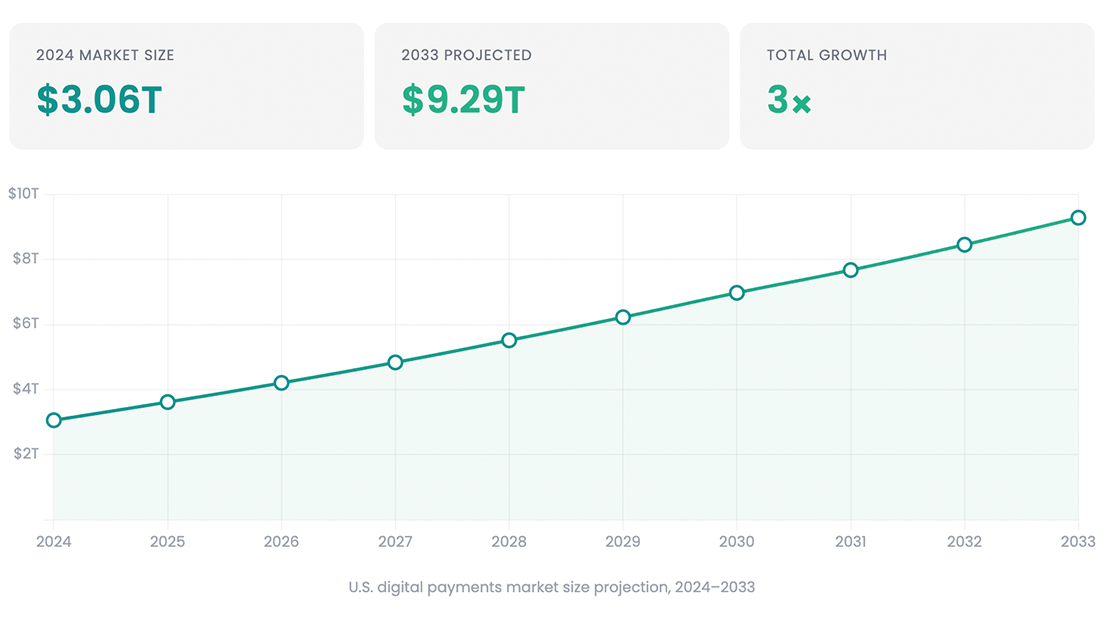
Meanwhile, the U.S. digital payments market is on a steep growth trajectory, projected to expand from $3.06 trillion in 2024 to $9.29 trillion by 2033. The question is no longer whether payments will evolve, but what is driving that evolution, and what it means for community financial institutions striving to stay competitive.
A Deeper Dive into the Payments Landscape in 2026
There are three forces shaping payments strategy today: the customer/member experience, fraud prevention and compliance, and operational efficiency.
Consumer expectations for fast, seamless, and real-time payment experiences continue to accelerate. Today, 70% of online adults are using digital payments, raising the bar significantly. Payments are no longer a back-end function, but a critical component of the overall customer/member experience. Financial institutions that fail to deliver frictionless payment experiences risk more than customer dissatisfaction; they risk lost revenue and stalled growth.
At the same time, banks and credit unions are juggling a different kind of real‑time demand: tightening fraud controls and staying on the right side of regulators, all while squeezing more efficiency out of every operation. Balancing airtight security, ever‑growing compliance checklists, and rising costs means automation, streamlined workflows, and modern infrastructure have officially moved from “nice to have” to “do it now.”
The Rise of Instant Payments and What it Means for Financial Institutions
A key catalyst in this shift is the rise of instant payments, which are quietly rewriting the rulebook on what consumers expect from their financial institutions. Being able to move money in real time, 24/7/365, is no longer a party trick—it’s rapidly becoming the minimum standard for a “modern” banking relationship.
The path forward, however, is anything but straightforward - especially for community institutions. While many can now receive instant payments, far fewer are truly set up to send them. Receiving is the lighter lift: it’s simpler to implement, carries less operational overhead, and has a much lower risk profile. Sending, by contrast, is where things get complicated, demanding real-time liquidity management, tighter fraud controls, and ‘always‑on’ oversight. It’s no surprise, then, that a meaningful share of institutions still isn’t ready to support outbound instant payments safely, confidently, and at scale.
A big culprit is the tech under the hood. Legacy cores and patchwork add‑ons make it hard to move quickly, hard to plug in new capabilities, and even harder to orchestrate them across fragmented stacks. The integrations required for instant payments are often expensive, lengthy, and resource‑intensive - and that’s before you factor in mounting cybersecurity concerns as new rails, APIs, and access points expand the attack surface. Together, these constraints are widening the gap between what customers are asking for and what many institutions can realistically deliver today.
What Lagging Banks and Credit Unions can do Today to Impact their Payments Business
Like everything in life, it starts with laying the groundwork.
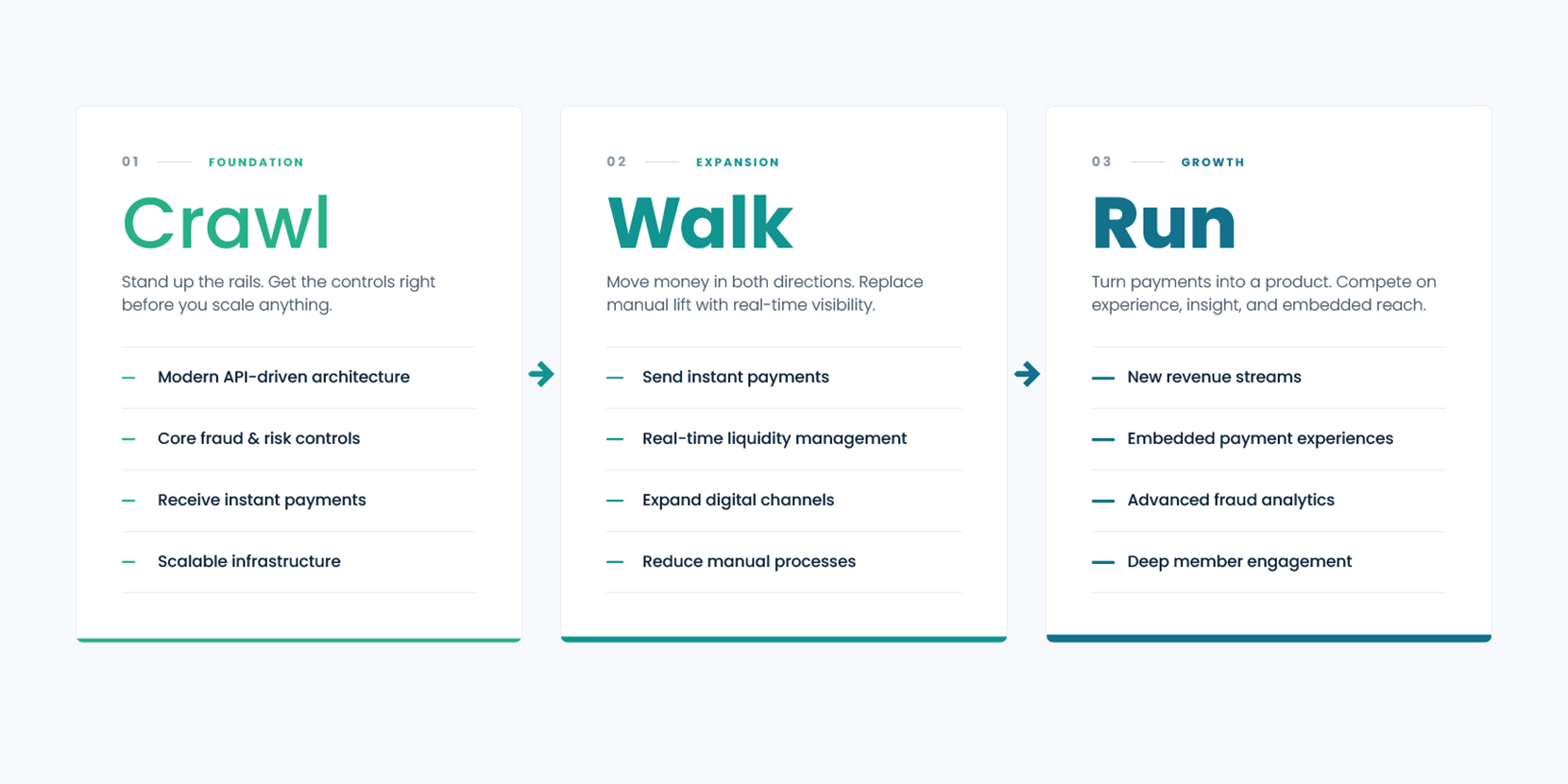
While instant payment capabilities are no longer optional, there is still a clear and practical path forward. Rather than chasing every new payment rail, financial institutions should focus on building a scalable, flexible payments platform. That foundation should include modern, API-driven architecture, integrated fraud and risk management, and scalable infrastructure designed for future capabilities without constant rework.
Those financial institutions that succeed take the crawl, walk, run approach, prioritizing foundational capabilities first, then layering in additional functionality as budgets and resources allow. This phased strategy reduces risk, avoids costly work, and enables more sustainable progress.
Treating Payments as a Strategic Growth Driver
Payments are increasingly emerging as a core driver of growth. Financial institutions that deliver advanced payment capabilities can unlock new revenue streams through increased transaction volume, expanded fee opportunities, and deepen customer/member engagement. Seamless, embedded payment experiences also improve retention, making the financial institution a more integral part of their customers’ daily financial lives. Operationally, modernized payment infrastructure reduces manual processes, streamlines operations, and lowers costs, creating efficiencies that extend across the organization.
The path forward isn’t about adding features as quickly as possible; it’s about modernizing with intention. Financial institutions should prioritize sustainable, phased transformation over short-term fixes. Building the right infrastructure today will enable long-term agility and growth.
Those that modernize the right infrastructure now aren’t just checking a box - they’re buying themselves future agility, resilience, and room to grow in a landscape that’s only getting faster and more complex. In the end, winning in modern payments isn’t about being the first to flip the “instant” switch; it’s about pairing speed with a smart, well‑sequenced strategy that your organization can execute. And you don’t have to chart that course alone - partnering with an experienced third party can help you avoid false starts, de‑risk key decisions, and accelerate your roadmap so you move quickly and confidently from day one.