Hidden Value in Your Debit Network
Bringing your debit program back into focus.
Table of Contents
01
The Overlooked Engine of Interchange
Behind every debit transaction is a network strategy that quietly determines how payments are routed, processed, and monetized.
Interchange income has long been a reliable non-interest revenue source for banks and credit unions. Every debit card purchase generates interchange revenue that offsets payment costs and funds technology investments and strategic growth. But amid economic shifts, regulatory pressure, changing cardholder behavior, and merchant routing, financial institutions are seeing declining interchange revenue without understanding why or what to do about it.
Interchange rates are only part of the equation. Behind every card transaction is a network strategy determining how payments are routed, processed, and modernized. Debit networks and card brands form the underlying plumbing of the payments ecosystem, yet for many institutions, these relationships were established years ago and rarely revisited. Contracts renew, and opportunities to improve performance go unnoticed simply because the program runs without issue. Payments often become a "set-it-and-forget-it" part of the institution, leaving value on the table.
This approach is becoming costly. For banks and credit unions combating declining interchange revenue, the opportunity isn't just to process transactions more efficiently — it's to optimize the entire payments ecosystem. A debit network strategy can uncover revenue opportunities, cut unnecessary expenses, and ensure every transaction delivers value and a great customer/member experience.
.png?width=4000&height=1000&name=Section%201%20Key%20Takeaway%20(1).png)
02
Payments Ecosystem 101: Where Debit Networks and Card Brands Fit
Most debit transactions operate on the four-party model:
.png?width=4000&height=2000&name=Section%202.1%20Payment%20Debit%20Network%20(2).png)
The logos on the front of a debit card, usually Visa or Mastercard, represent global card brands. These brands set operating rules, provide worldwide acceptance, manage authorization standards, and enable signature-based debit transactions. They also determine the Visa and Mastercard interchange programs that compensate issuers for each qualifying transaction. But this is just one layer of the ecosystem.
Debit cards also route through regional networks — such as NYCE, STAR, Accel, and Pulse — traditionally known as PIN networks. These networks support PIN-authenticated, contactless, and digital debit transactions, each maintaining its own interchange schedules, fees, processing rules, incentive programs, and merchant acceptance footprint.
This simple graph shows how a single card swipe generates interchange income for the financial institution and cost for the merchant.
Your debit network strategy defines how your institution participates in this ecosystem, answering three questions:
- Which debit networks the institution participates in
- How those networks are prioritized
- How pricing, incentives, contracts, and routing provisions are structured
Debit network agreements typically include interchange rates, network fees, incentives, routing provisions, term and exclusivity clauses, and performance commitments.
Key Takeaway
Assign clear ownership of your debit network program to a single accountable person or team. Don't let it run unmanaged simply because it works — schedule regular reviews across operations, retail, and IT to close oversight gaps, control costs, and capture revenue that would otherwise go unnoticed.
03
Three Warning Signs Your Debit Network Needs a Second Look
A debit program that was well aligned years ago may no longer reflect today’s realities. The issue is not necessarily that the wrong networks were chosen; it is that the environment changed.
.png?width=4000&height=2000&name=Section%203%20Payment%20Debit%20Network%20(1).png)
Warning Sign 1: New laws and regulations are outpacing your contracts
Institutions have watched The Illinois Interchange Fee Prohibition Act (IFPA) closely, wondering whether its impact will stay confined to Illinois. Federal regulators have already acted for nationally chartered institutions, leaving state-chartered institutions to navigate IFPA on their own. In June 2026, NCUA finalized an interim rule asserting "exclusive authority over federal credit unions' ability to charge non-interest fees and charges," preempting state laws on payment card fees, including interchange — following a similar preemption rule from the OCC earlier this year.
Still, since the Durbin Amendment passed over 15 years ago, laws limiting interchange keep resurfacing in Congress and state legislatures. IFPA's core premise — not assessing interchange on taxes or tips — is politically appealing enough that it's unlikely to disappear even if defeated now.
Institutions in Illinois, or in states with similar momentum such as Georgia, Kentucky, California, or Wisconsin, need to model how much interchange could decline if lower transaction totals (net of tax and tip) become reality. Costs may shift first in affected states, but payment companies will likely spread them across their entire footprint. Forecasting this impact is difficult because many institutions lack an objective way to assess performance — often because their debit network relationship is bundled into their processor contract from settlement through invoicing. These laws make it more important than ever for community institutions to take a closer look at their debit networks.
Warning Sign 2: Account holder profile has shifted
Interchange revenue has been steadily eroding for over a decade. According to Federal Reserve data, the average debit interchange fee fell from $0.31 per transaction in 2011 to $0.27 in 2024 — a modest drop per transaction, but one that compounds across hundreds of thousands of transactions.
Community institutions have felt this acutely because their customer bases often skew toward older generations who use debit less and spend differently as they age. Meanwhile, Millennials and younger generations prefer debit when paying by card: 71 percent say it's the payment method that feels most financially sound, according to a U.S. News survey.
An institution's demographic mix has likely shifted since its debit network decisions were made — in many cases before today's Millennial accountholders were even born. Interchange revenue suffers not because it's out of the institution's control, but because the debit program is out of sync with actual accountholder activity. Maximizing interchange today requires a more holistic view than when most networks were originally selected — factoring in ATM and online debit card transactions, not just point-of-sale purchases. Given the long tenure of most debit network relationships, executives are often unaware of how much has changed.
Warning Sign 3: Debit network landscape has changed
Community institutions used to face a revenue-versus-experience tradeoff: some providers offered better economics but lacked debit network coverage, forcing a compromise between cost, revenue, and reach. That tradeoff no longer applies. Today's networks — shaped by regulatory change, M&A, and legal battles — offer broad, often nationwide coverage, and every debit card carries two unaffiliated networks. Access is no longer a competitive differentiator, so stop evaluating your program on coverage alone.
Instead, audit how your debit program is structured and managed. Map your network strategy to where cardholders actually transact — online and at ATMs, not just point of sale. Review your ATM network strategy and exposure specifically: most institutions carry far more debit cards than ATMs, meaning greater risk of foreign ATM costs than surcharge revenue from their own machines, and competitor ATM footprints have expanded significantly in the past five years.
Revisit your debit network contract on the same timeline as your strategy. As coverage standardizes industry-wide, competitive advantage no longer comes from being on the right networks — it comes from actively optimizing contracts, routing, pricing, and incentives to capture the full value of every transaction.
Key Takeaway
Stop relying on network participation alone for competitive advantage. Regularly audit your contracts, routing, pricing, and incentives to ensure they align with how account holders actually use debit today.
04
Why “Set‑It‑and‑Forget‑It” Debit Programs Cost Too Much and Earn Too Little
Debit network programs can become one of the institution's largest non-interest revenue streams, yet remain among the least scrutinized.
Banks and credit unions often negotiate a contract once, then leave the program untouched for years without a single point of contact. That approach may have made sense years ago, but the card network economics have fundamentally shifted.
Interchange income now faces pressure from multiple directions: regulatory scrutiny continues to influence pricing, and digital-first behavior keeps shifting. Meanwhile, debit networks regularly adjust pricing, incentives, marketing programs, and fees — together reshaping the profitability of every transaction.
How Routing Erodes Net Interchange
Every debit card carries at least two unaffiliated debit networks, giving merchants routing choices — but this creates unintended consequences for issuers. Merchants and their payment providers increasingly use least-cost routing to direct eligible transactions to the cheapest network for acceptance, a decision designed to cut merchant costs, not maximize issuer interchange.
The financial impact can be significant: a transaction routed to a lower-cost network may generate less interchange income, different incentive payments, or a different fee mix than the institution anticipated when the program was designed. As routing patterns shift, net interchange margin can steadily decline even when overall transaction volume remains healthy.
The Hidden Cost of Bundled Contracts
Many institutions don't realize how much routing has changed because they rarely analyze performance at the individual network level. Bundled network-processor relationships and complex invoices obscure true net income and expense by network and channel. Institutions that outperform aren't necessarily processing more transactions — they're continually evaluating their relationships and contract terms.
Key Takeaway
Don't chase transaction volume to grow interchange revenue. Instead, schedule regular reviews of your debit routing strategy, relationships, routing behavior, and contract terms — that's what separates outperforming institutions from the rest.
05
Aligning Card Brands, Debit Networks, and Routing to Maximize Net Interchange
Every debit transaction's profitability is shaped by layers of pricing, routing, incentives, fees, and contracts — no single decision determines it.
Optimizing debit interchange is no longer about picking one card brand or negotiating the highest published rate. The strongest programs align card brands, debit networks, routing, and contract terms across every transaction channel.
Each transaction moves through an ecosystem of card brands, debit networks, merchants, acquirers, and processors — and whichever network ultimately processes it determines not just interchange income, but fees, incentives, and overall card network economics.
As consumer behavior shifts toward digital wallets, e-commerce, contactless, and recurring payments, institutions need a routing strategy that reflects how accountholders use their cards today — not how they used them when current contracts were signed. The goal is no longer optimizing one piece of the puzzle, but aligning contracts, network configurations, and routing to maximize long-term value across the entire debit portfolio.
Channel Mix and Interchange Categories
Not every debit transaction behaves the same way. A card-present grocery purchase follows a different path than an online subscription payment or an ATM withdrawal, and each channel carries its own interchange schedule, fees, routing options, fraud considerations, and rules.
As volume migrates toward digital commerce, institutions need to understand how revenue and expense differ across point-of-sale, e-commerce, mobile wallet, recurring payment, and ATM transactions. A program optimized mainly for in-store purchases may no longer reflect where today's interchange opportunities actually exist.
Understanding channel mix lets institutions evaluate whether current network participation and routing priorities still match customer behavior and maximize net return.
Incentives, Fees, and Network Selection
Published interchange rates tell only part of the story. Every card brand and debit network offers its own mix of incentive programs, marketing funds, network fees, processing costs, and contractual commitments — variables that can significantly shift a debit program's true profitability.
Meanwhile, merchants and their payment providers increasingly determine which eligible network processes each transaction through least-cost routing. This reduces merchant costs but can shift transactions toward networks that generate lower returns for the issuer.
Institutions that consistently outperform understand network economics beyond interchange alone. They periodically evaluate how incentives, routing behavior, fee structures, and contract terms interact across the ecosystem — optimizing total program performance, not just individual pricing metrics.
Bringing it Together
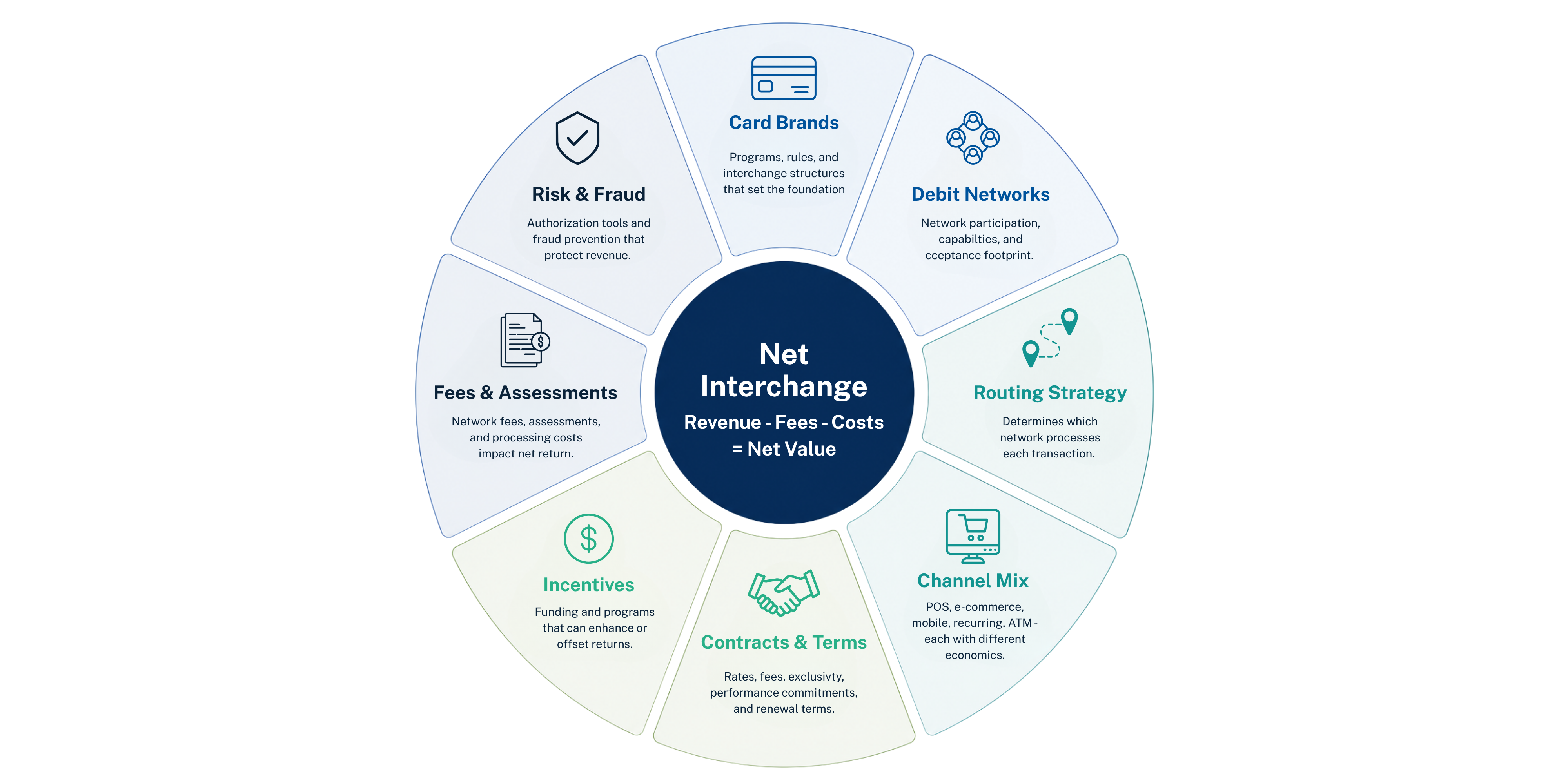
Every debit transaction is shaped by multiple interconnected decisions. The illustration below shows the eight components that collectively determine net interchange performance.
Key Takeaway
Don't stop at choosing the right network. Regularly align card brands, routing behavior, incentives, fees, and contract terms across your entire debit portfolio to optimize debit interchange.
06
Why Many Debit Programs Are Blurred and Unmanaged
With contracts renewing and routing strategies coasting unchecked year after year, every cycle without a review is another cycle of revenue quietly left on the table — while competitors who do look are already capturing it.
The result: many institutions have gone five, 10, even 20 years without a comprehensive review of how their debit program is actually performing — while interchange regulations evolved, merchant routing shifted, and digital commerce accelerated around them.
Debit Program Governance
One of the biggest reasons debit programs stagnate is that no single executive truly owns them. Responsibilities scatter across operations, retail, finance, and IT — each group owns a piece, but no one owns the outcome.
Without clear debit network oversight, institutions manage operational tasks instead of strategic results. The program keeps running, but no one can say whether it's as efficient or as profitable as it could be — and every quarter that gap goes unexamined, competitors who are asking the question pull further ahead.
Misconceptions That Delay Action
Many assume declining interchange is just an industry trend — a misconception that masks program-specific misalignment and real opportunity. Industry forces affect every institution, but not every debit program equally. Two institutions with nearly identical asset sizes and transaction volumes can post wildly different financial outcomes, driven entirely by network strategy, contract terms, routing priorities, card brand participation, and fee structures. The trend is shared; the results aren't — and that gap is exactly where the opportunity hides.
Key Takeaway
Commission an independent debit program review to separate market realities from institution-specific opportunity. Use it to assign clear ownership of the program to a single accountable executive, rather than leaving responsibilities scattered across operations, retail, finance, and IT. Benchmark your network strategy, contract terms, routing priorities, and fee structures against peers of similar size to determine what's driven by industry-wide pressure versus what's specific to your program — and revisit that review on a set cadence, not just when a contract happens to come up for renewal.
07
A Data-Driven Approach to Debit Network Strategy
Institutions still treating debit as background utility are already falling behind — the strongest long-term results go to those who elevate it to a strategic product line.
A modern approach to debit network optimization starts from a simple premise: no two institutions share the same account holder mix, transaction behavior, regulatory exposure, or digital payment activity. Debit strategy, therefore, cannot be one-size-fits-all — it must be purpose-built for each institution's specific risk and revenue profile.
From Static Contracts to Dynamic Strategy
Leaders should be able to answer four questions at any given time:
- How are transactions being routed across channels?
- Where are account holders spending?
- How much does each network contribute to income?
- How much does each network contribute to expense?
Without this visibility, contract decisions default to assumptions rather than data. Today's payments environment moves too fast for a set-it-and-forget-it approach — institutions that periodically review their network strategy are far better positioned to respond to change than those still operating under contracts negotiated years ago.
Using Data and Simulation to Guide Decisions
A net interchange simulation across alternative network options helps institutions identify the mix that best fits their objectives. Rather than relying on estimates or vendor projections, banks and credit unions can model how their actual transaction portfolio would perform under different network configurations — before making any contractual changes.
Key Takeaway
A strong simulation can reveal the following points of clarification:
-
What happens if a different network is selected
- How routing priorities affect interchange income
- Whether a different network lowers fees
- Which combination best balances revenue, expense, experience, and regulation
08
How Engage fi Evaluates and Optimizes Debit Networks
At Engage fi, we believe debit programs should be actively managed, not simply renewed every few years. Our debit network evaluation offers a structured, independent, vendor-agnostic approach that realigns your program with today's realities.
What We Review and Analyze
- Contract and invoice review
- Transaction and routing analysis
- Benchmarking of gross and net interchange
- Scenario modeling across networks and brands
Our objective is simple: help your institution maximize income, reduce expense, and mitigate risk — while staying competitive and top-of-wallet.
Vendor-Agnostic, Experience-Driven Guidance
Our payments consulting for banks and credit unions is personalized to each institution's specific needs and goals. Education is the foundation of our approach — we ensure clients are equipped to make informed decisions, both now and in the future.
Our people make us different. Every engage fi team member is hand-selected for deep domain expertise and industry experience, bringing perspective from both sides of financial services. Many have worked for leading technology providers, giving them insider knowledge of vendor contracts, pricing, incentives, and negotiations. Others built their careers at banks and credit unions, facing the same challenges our clients face today. Having sat in your seat, they understand your priorities and realities — and deliver experience-driven guidance you can act on with confidence.
The Engage fi Approach to Debit Network Consulting
Independent advice leads to better decisions.
Our recommendations are driven entirely by your institution's data, objectives, and long-term strategy — never by vendor relationships. That independence is what lets us uncover opportunities others miss, negotiate from a position of strength, and deliver measurable financial outcomes. Institutions still relying on vendor-guided advice are leaving that leverage on the table.
09
Real‑World Revenue Lift and Expense Reduction
Engage fi helps institutions identify the right relationships and negotiate preferential contract terms. The results of some of our debit network case studies speak for themselves.
A 36% Increase In Interchange Income
Engage fi’s partnership with Bayer Heritage Financial Credit Union resulted in a transformative outcome that aligned expectations, streamlined efficiencies, and had a debit interchange revenue lift. Years ago, Bayer Heritage had a rewards program with a former vendor that was phased out over time due to cost and lack of value to the membership. The savings and incentives Engage fi achieved through negotiations with the credit union’s new card vendors was so significant it funded Bayer Heritage’s debit and credit card 100% redemption cashback rewards program, serving as an additional tool to incentivize current and future members.
10x Increase in Net Interchange Income
Under the guidance of Engage fi, this financial institution underwent a debit network optimization, which aligned with their stakeholder requirements and provided significant reductions in network expenses. Additionally the revamped debit and credit processing program introduced new features and incorporated contactless functionality, catering to modern user needs. Through negotiations, the financial institution’s net interchange income was increased by over ten times. They also received more than twice the card brand incentives compared to their previous agreement while reducing debit network expenses by a third. Moreover, the card brand partner is committed to bolstering support and incentives for future initiatives.
151% Increase in Growth-Based Incentives
Engage fi partnered with OceanAir Federal Credit Union on a comprehensive payments evaluation where they signed new brand and network contracts and transitioned their card processing from full-service to self-service. The credit unions’ new contracts yielded significant savings: monthly processing costs were reduced by over 50%, ATM fees were dropped by 68%, and volume and growth-based incentives increased by 151%. The credit union highlighted that this project delivered the most significant cost savings they have ever achieved across any contract within the organization.
10
Is It Time to Reevaluate Your Debit Network?
A periodic debit program health check helps determine whether network strategy, contracts, and routing practices still align with business objectives.
Debit Network Assessment Checklist: Five Questions for the C‑Suite
- When was the last time my financial institution completed a comprehensive review of our debit program?
- Have we ever had an independent, vendor-agnostic evaluation of our debit network strategy?
- Do we understand how every debit network contributes to our net interchange income?
- Can we clearly explain how our transactions are routed across in-store, online, mobile, and recurring payment channels?
- Would we be prepared to negotiate our debit contracts if they came up for renewal tomorrow?
When to Review Debit Contracts
- Your last debit network evaluation was conducted more than five years ago.
- Your bank or credit union has never completed an independent debit program review.
- Your customer/member demographics have changed through growth, mergers, or market expansion.
- Your customers/members pay differently than they did the last time your contracts were negotiated.
- Your institution cannot easily identify which debit networks generate the highest net financial return.
- You are preparing for regulatory challenges, such as the Illinois Interchange Fee Prohibition Act (IFPA) or other emerging legislation.
Decision Point
If your bank or credit union identified one or more items on the debit network assessment checklist, now may be the time to conduct a structured, data-driven evaluation.
11
Next Steps: Schedule a Debit Network Health Check with Engage fi
Collaborating with the right partners can strengthen payments offerings, improve non-interest income, and reduce risk.
What to Expect
During an Engage fi payments consultation, we work as an extension of your team to understand your payments portfolio, uncover opportunities and risks, and develop strategies that improve performance.
Discovery
We begin by thoroughly gathering your business requirements and strategic initiatives to gain a deep understanding of your unique challenges and goals. Our discovery process is designed to not only identify areas where you can differentiate yourself in the market but also to pinpoint opportunities for improving operational efficiencies
Evaluation
We guide you through the evaluation process, equipping you with the knowledge and insights necessary to make strategic decisions and stay competitive in a rapidly evolving environment. Our team helps you select vendors for the evaluation, ensuring that each candidate is thoroughly assessed. We conduct detailed demonstrations and highlight the strengths and weaknesses of each vendor. This comprehensive approach allows you to make an informed decision, confident that you are choosing the best partners for your business.
Selection
We ensure that the chosen providers not only meet your business needs and strategic goals but also align with your cultural values. Through exploration demos, executive partnership forums, and reference onsite visits or calls, we provide you with a holistic view of each vendor. We complete a thorough gap analysis, ensuring that any potential custom needs or discrepancies are addressed, and ultimately help you select the vendor partner that best fits your organization. This process is designed to give you the confidence and clarity needed to make a well-informed decision.
Negotiation
Leveraging our proprietary tools and technology, we work to maximize your savings and reduce expenses. We negotiate business terms on your behalf, ensuring that the agreements benefit your organization and mitigate any potential risks. After successfully executing the contract, we facilitate a smooth conversion transition, ensuring that the implementation process is seamless and aligned with your business objectives. Our goal is to empower you with the best possible terms and conditions, allowing you to focus on your core business activities.
Guiding Financial Insitutitions Toward a Stronger Future
Position your bank or credit union to thrive as a modern, efficient, and sustainable organization. Focus on supporting your customers and members today while adapting to meet future challenges.