The Private Banker in Every Pocket Works for Meta
AI agents are transforming banking by making it easier for customers to move their money. Community banks must act now to retain their clients before...

Navigate this high stakes process with precision.
A solution delivering fast, efficient, and accurate core data.
Digital solutions to grow, scale, and outperform.
Reliable, efficient, and integrated core platforms deliver results.
Select modern communications channels to integrate with core and digital solutions.
Strategic Planning
Support services for the strategic planning process at every level.
M&A Planning
Realize the key value drivers resulting from your merger or acquisition.
Performance Benchmarking
Tailored metrics and benchmarks designed to assess relationships.
Organizational Efficiency
Enhance efficiency across branches, digital channels, and contact centers.
A digital library of industry news, analysis, best practices, and thought leadership tailored to the challenges and opportunities faced by financial institutions.
Our in-depth analysis of conversion strategies, M&A activity, and the evolving landscape of financial services.
Explore our webinars, insights, videos, and upcoming events for financial institutions.
Stay up to date with the latest news and announcements from Engage fi.
For 360fi Workflow clients only. Sign in to access the workflow library and other guides, forms, and tutorials.
Key Takeaways from This Blog:
A depositor who has kept $30,000 in a low-rate savings account for 15 years looks loyal. They may simply be busy.
Moving money takes work. Depositors must notice a better offer, research the institution, read the fine print, decide whether the difference matters, and then act. That effort keeps a lot of deposits in place.
AI removes much of that friction. And it makes it easier to answer a question many institutions may not be ready to answer: "Should I still bank here?"
Autonomous agents are not about to sweep deposits from one institution to another overnight. But AI does not need authority to move money to influence where it goes. It only needs to make the comparison easy.
We have already seen when friction disappears. In March 2023, Silicon Valley Bank depositors withdrew $42 billion in a single day, largely through mobile apps and group chats. That was panic, not comparison shopping, but it showed how fast deposits move once moving them is easy.
A recent Financial Times Lex column estimated that AI agents helping savers secure better rates could put as much as $500 billion of U.S. bank equity value at risk. It is a scenario, not a forecast. The underlying point stands: the cost of switching is falling.
That matters because friction looks a lot like loyalty. A customer or member who has stayed 15 years may trust you and value your service. They may also stay because direct deposit is set up, the debit card works, the app is familiar, and changing everything sounds irritating. Often, it’s a combination of each.
Which leads to the question every CFO and ALCO should be asking:
What share of your deposits are relationship deposits, and what share simply have not moved yet?
Your deposit beta assumptions, rate-sensitivity models, and core deposit valuations all depend on the answer. AI may change those assumptions faster than your models expect.
When comparison gets easier, the instinct is to raise rates. That works until everyone does it. Then the industry enters another expensive deposit contest on the one feature consumers can compare instantly. That is not differentiation. It is an auction.
Consider the math. On $30,000, a competitor paying 30 basis points more earns the customer about $90 a year. If the current institution saves them more than that through better loan pricing, lower fees, stronger rewards, or simply not having to re-route automatic payments, staying is the better financial decision.
A well-designed AI assistant could reach that conclusion and recommend staying. But only if the value can be identified, calculated, and seen.
The American Bankers Association has argued that a deposit is not simply a yield product. It comes with payment access, fraud monitoring, dispute resolution, branch and ATM access, liquidity, and federal deposit insurance. Credit unions can add member ownership, local service, financial guidance, and relationship pricing.
None of that counts if no one can quantify it.
Banks and credit unions have emphasized relationship banking for decades, yet many still manage products one at a time. Checking sits in one system, the mortgage in another, cards somewhere else, and wealth management in its own database.
The institution sees a relationship. The consumer sees fragments. The AI sees even less.
That fragmentation may be the first weakness AI exposes. Most institutions already hold the data they need. The hard work is connecting it at the household level and measuring the value exchanged in both directions: what you earn from the relationship, what you return through pricing and benefits, and whether the customer sees enough value to stay.
A relationship can be valuable to the customer and marginal to you. The reverse is also true. You need to know both.
This is not a marketing project. It is an enterprise discipline. Finance must quantify the economics. Product must define the value. Data and technology must connect the relationship. Marketing must make that value visible, but marketing cannot create value after the fact.
Leadership teams can begin with four steps this quarter:
1. Segment deposits by behavior, not tenure. Separate engaged, multi-product households from single-product balances that are rate-sensitive who may be staying out of convenience.
2. Build household-level profitability. Start with your top 20% of households by deposit balance. A rough model beats no model.
3. Find out which benefits actually drive retention. Test them against your attrition data instead relying on assumptions.
4. Ask the machines. Ask ChatGPT, Gemini, and Copilot whether a customer should stay with your institution or move and read the answers closely. Then publish your rates, fees, and relationship benefits in clear, structured form that both consumers and AI systems can read.
In a previous article, AI Is Changing How Consumers Find Banks, I explored how institutions can earn a spot on the shortlist when consumers ask AI where to bank. That was the visibility challenge.
The next challenge is retention. The advantage will not belong to the institution with the highest rate. It will belong to the one that knows what the relationship is worth to the customer and the institution, and can prove it.
Getting found by AI is only the beginning.
Soon, AI may also be the one asking whether you still deserve the deposit.
AI agents are transforming banking by making it easier for customers to move their money. Community banks must act now to retain their clients before...

Discover how Robinhood's agentic trading transforms finance by enabling AI to manage investments, making banking relationships more portable and...
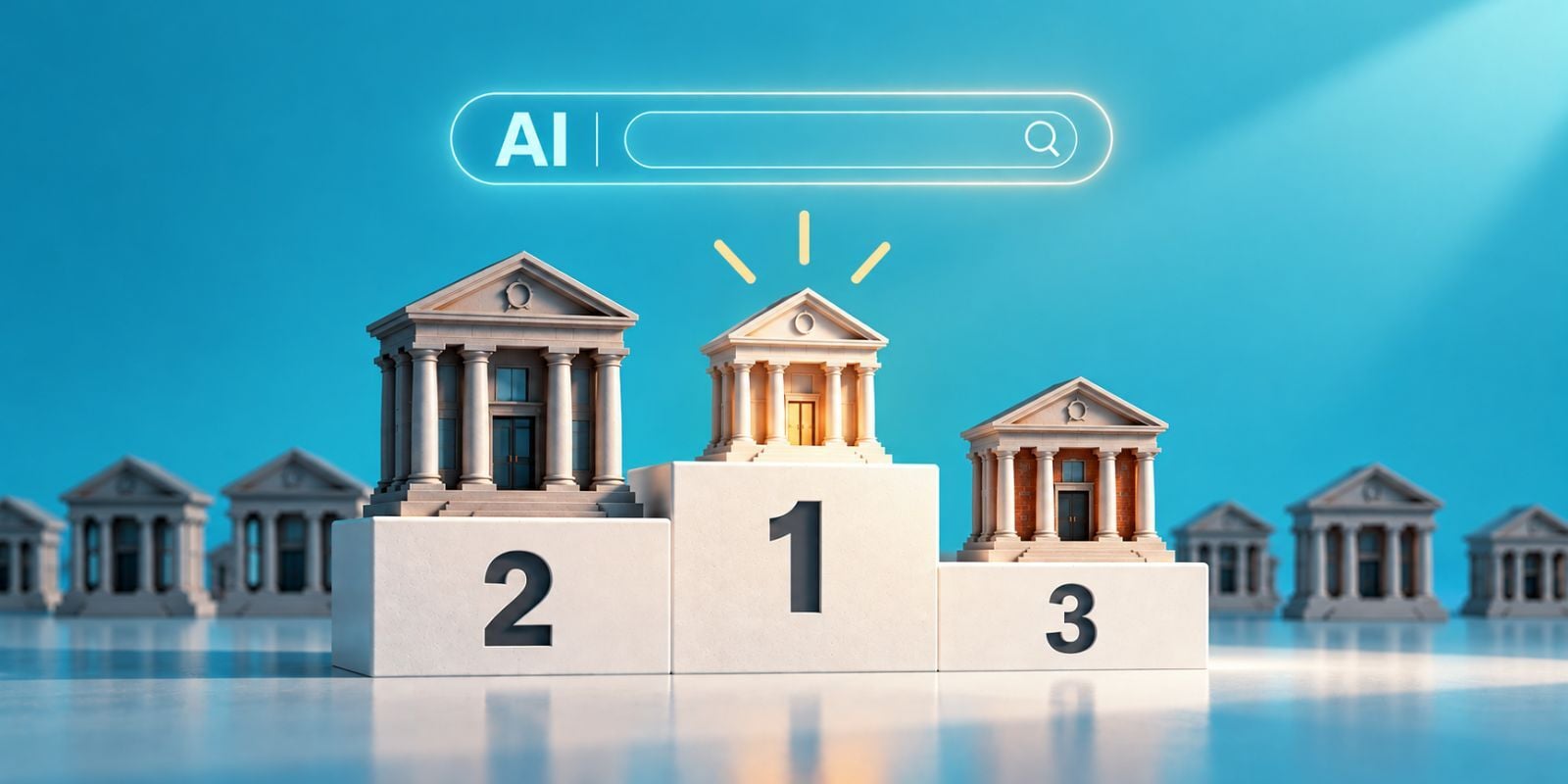
AI is transforming how consumers discover financial institutions, allowing smaller banks and credit unions to compete on relevance and clarity rather...