The Digital Universal Banker, Now with Instant Rails
Key Takeaways From This Blog: The Universal Banker is evolving into a digital, real-time advisor powered by AI, instant payment rails, and...
Navigate this high stakes process with precision.
A solution delivering fast, efficient, and accurate core data.
Digital solutions to grow, scale, and outperform.
Reliable, efficient, and integrated core platforms deliver results.
Select modern communications channels to integrate with core and digital solutions.
Strategic Planning
Support services for the strategic planning process at every level.
M&A Planning
Realize the key value drivers resulting from your merger or acquisition.
Performance Benchmarking
Tailored metrics and benchmarks designed to assess relationships.
Organizational Efficiency
Enhance efficiency across branches, digital channels, and contact centers.
A digital library of industry news, analysis, best practices, and thought leadership tailored to the challenges and opportunities faced by financial institutions.
Our in-depth analysis of conversion strategies, M&A activity, and the evolving landscape of financial services.
A podcast channel for the time-constrained banking professional delivering sharp insights on fintech, strategy, and leadership to help you stay ahead in a fast-changing financial world.
4 min read
James White
:
12/12/25 11:39 AM
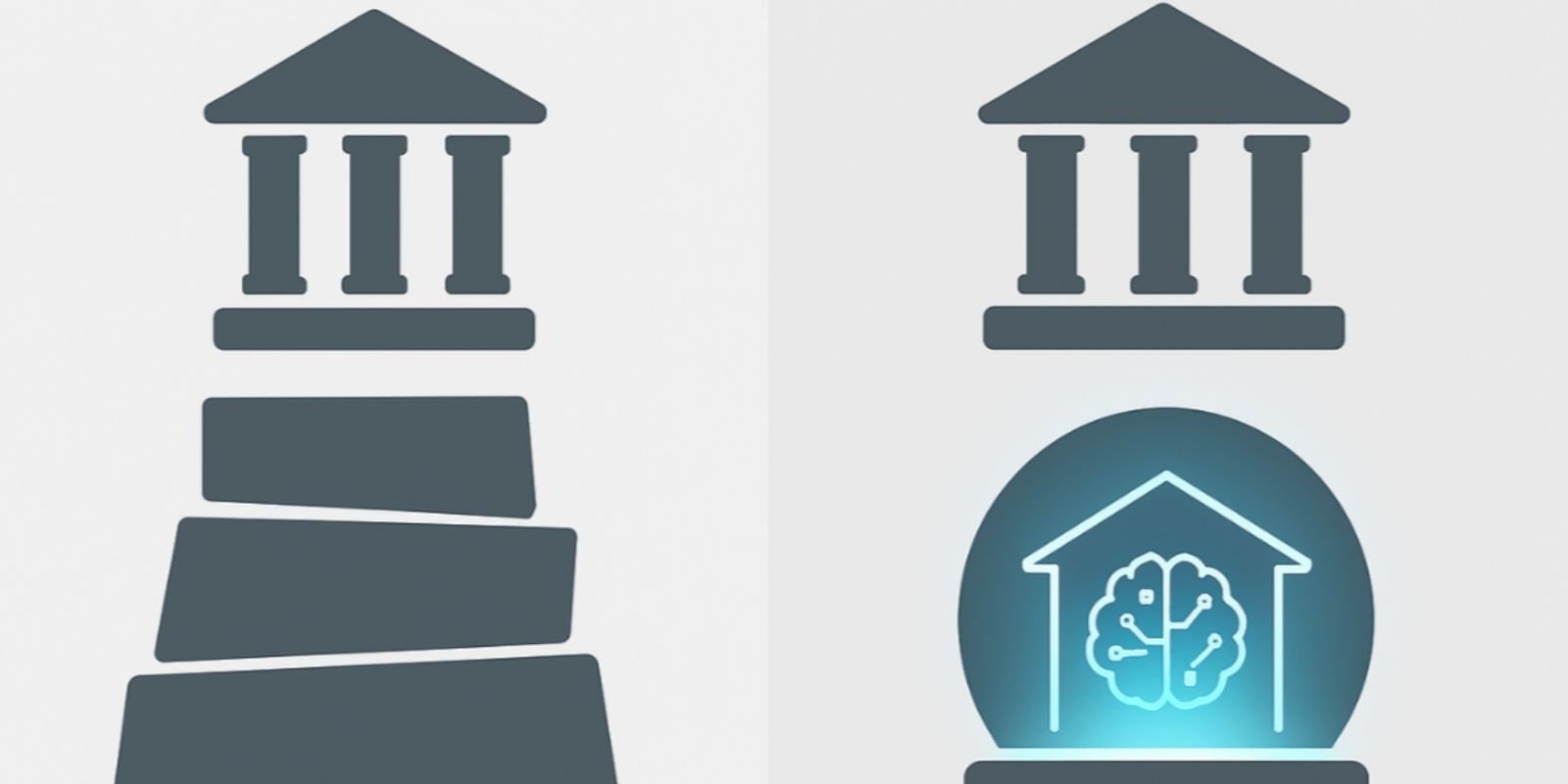
Financial institutions keep talking about "adding AI" to their operations. Installing chatbots. Deploying fraud detection models. Automating back-office processes. These are valuable improvements, but they're not AI-native banking. That's retrofitting intelligence onto existing infrastructure.
AI-native banking means building differently from the start. Not bolting intelligence onto legacy systems, but designing architectures where AI functions as the central operating system. Autonomous agents handle end-to-end processes. Real-time personalization happens at the edge. Banking doesn't just use AI. Banking runs on AI.
The forecast says this will become mainstream in 2026. But institutions waiting until 2026 to start building will find themselves playing catch-up.
The Short Answer: Autonomous Agents Handle Routine Banking
AI-native banking runs on autonomous agents. Not chatbots that answer FAQs. Agents that operate independently, making decisions in real time without human handoffs.
An agent monitors a customer or member's spending patterns, predicts a cash flow dip three weeks out, and proactively offers a microloan with terms customized to that consumer's repayment history. No call center. No loan officer. No three-day underwriting process. The agent handles origination, risk assessment, and approval in seconds.
Projections suggest agents will handle 40 to 60 percent of routine banking tasks by 2026. Not assist with, but handle. That's not incremental efficiency. That's fundamental restructuring of how banks operate.
The technology already exists. Temenos and Finastra have roadmaps targeting full AI-native rollouts aligned with 2026. Early pilots at U.S. neobanks are scaling now. Generative AI models are getting cheaper. Edge computing is becoming ubiquitous. The infrastructure is ready. The question is which institutions will move first.
Why This Matters for Consumer and Deposit Retention
In a high-interest-rate environment, financial institutions face deposit flight to money market funds and high-yield alternatives. AI-native banking counters this by making the banking relationship sticky.
Personalization increases engagement by 25 to 30 percent. That's Bain data showing customers and members who receive proactive, contextually relevant nudges maintain higher balances and switch accounts less frequently.
An AI agent notices you direct deposit your paycheck and immediately offers a half percent APY boost if you opt into auto-sweep to savings. During Black Friday, your app suggests a tailored rewards boost based on live transaction data. When you book travel, the system adjusts your credit limit preemptively to avoid declined transactions.
These aren't features that customers and members request. They're experiences they remember. And sticky relationships keep deposits in-house.
Models show AI-driven personalization could retain 15 percent more checking and savings balances for mid-tier U.S. banks and credit unions, which translates to over $200 billion industry-wide. Autonomous agents also cut operational costs by 20 to 35 percent, freeing budget to offer competitive yields without sacrificing margin.
The business case is clear. Financial institutions that deploy AI-native systems can retain more deposits at lower cost while delivering better experiences.
What Nobody's Saying Out Loud
AI-native banking requires a governance infrastructure that most banks are still building. The CFPB's 2025 AI guidelines mandate transparency in automated decisions. Non-compliance triggers significant penalties. AI-native systems amplify both opportunity and risk. An agent that processes thousands of loan applications can identify patterns humans miss. It can also perpetuate bias at scale if not properly monitored.
Generative AI can hallucinate. An agent giving incorrect advice about tax-advantaged deposits creates liability. A data breach exposes millions of records. Edge computing speeds processing but decentralizes control, making audits more complex.
Banks and Credit Unions building AI-native systems need governance frameworks where humans oversee high-stakes actions. That requires infrastructure many institutions are working to implement. It requires expertise some financial institutions are actively hiring. And it requires recognizing that speed and autonomy create risks regulators will scrutinize closely.
The challenge is real. But the alternative creates its own risks. Institutions that move too slowly may find competitors have captured market share that's difficult to win back.
Who's Already Doing This
Grasshopper Bank launched a natural language interface in September 2025. Small business owners query, "What's my burn rate this quarter?" in plain English. The system pulls real-time ledger data and responds with actionable insights. Agents handle 70 percent of queries autonomously. Retention increased 18 percent in pilots.
Capital One evolved Eno from a chatbot into an agentic fraud prevention system. Agents don't just flag suspicious transactions. They resolve issues autonomously, including auto-refunding disputed charges. The 2026 extension ties agents into deposit strategies with dynamic APY adjustments based on customer and member behavior.
These aren't experimental programs. They're production systems serving real customers and members at scale. The technology works. The business case closes. What's missing is widespread adoption by institutions that control the majority of U.S. deposits and relationships.
What Happens Next
Financial institutions will adopt AI-native systems at different speeds. Institutions facing deposit pressure or competitive threats from fintechs will move fastest. Banks and credit unions with stable customer and member bases and strong compliance records will move slower.
But the direction is clear. AI-native banking isn't a 2026 prediction. It's a 2025 reality that becomes unavoidable in 2026. Regulators are watching. Customers and members are comparing. Competitors are building.
AI doesn't replace humans. It replaces human inefficiency. AI-native banking doesn't replace traditional banking. It replaces the inefficiency of manual underwriting, reactive customer service, and one-size-fits-all product offerings.
The Bigger Picture
Legacy financial institutions built infrastructure designed for batch processing and branch transactions. That infrastructure served customers and members well for decades. What's changing is expectations: instant payments, real-time personalization, and always-available autonomous service.
Retrofitting AI onto legacy cores delivers incremental improvement. Building with AI as the foundation enables transformation. The gap between those two approaches determines competitive positioning.
Financial institutions that deploy AI-native systems will have opportunities to retain deposits, reduce costs, and deliver differentiated experiences. Institutions that move more deliberately will need to explain their timeline to boards and stakeholders.
The forecast says 2026 is the inflection point. The reality is that banks and credit unions not planning now may find the transition more challenging than expected. Strategic advantage goes to those who start building today.
Key Takeaways From This Blog: The Universal Banker is evolving into a digital, real-time advisor powered by AI, instant payment rails, and...
In an era where technology is revolutionizing every aspect of our lives, the financial sector is no exception. The traditional banking model is being...
The banking industry is experiencing a shift in how its customers conduct their financial business. When the last of the Baby Boomer generation makes...