 James White
What to Tell Your Board About the Repricing of Your Charter
 Virginia Heyburn : 6/5/26, 2:45 PM
Regulatory changes are reshaping the banking landscape, challenging community banks to adapt their strategies amid rising fintech competition.
Navigate this high stakes process with precision.
A solution delivering fast, efficient, and accurate core data.
Digital solutions to grow, scale, and outperform.
Reliable, efficient, and integrated core platforms deliver results.
Select modern communications channels to integrate with core and digital solutions.
Strategic Planning
Support services for the strategic planning process at every level.
M&A Planning
Realize the key value drivers resulting from your merger or acquisition.
Performance Benchmarking
Tailored metrics and benchmarks designed to assess relationships.
Organizational Efficiency
Enhance efficiency across branches, digital channels, and contact centers.


A digital library of industry news, analysis, best practices, and thought leadership tailored to the challenges and opportunities faced by financial institutions.
Our in-depth analysis of conversion strategies, M&A activity, and the evolving landscape of financial services.
Explore our webinars, insights, videos, and upcoming events for financial institutions.
Stay up to date with the latest news and announcements from Engage fi.
For 360fi Workflow clients only. Sign in to access the workflow library and other guides, forms, and tutorials.
Key Takeaways from This Blog:
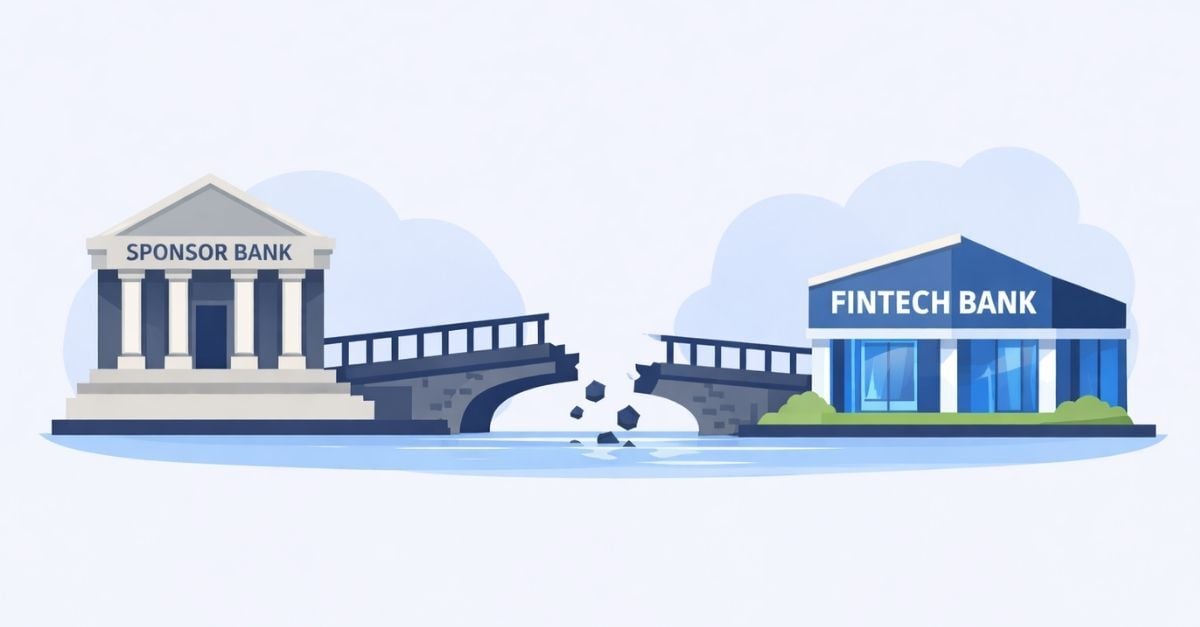
Fintechs are abandoning BaaS for charters: Scaled fintechs now see sponsor bank relationships as costly, risky, and limiting, and are bringing deposits, payments, and lending in-house.
Cost-of-funds advantages are decisive: Bank charters give fintechs structural funding advantages (170–187 bps), creating durable ROE moats that community banks can’t match through rate competition.
Community banks face a strategic reckoning: BaaS revenue was temporary, not durable; banks without true relationship-based differentiation are exposed to permanent margin and deposit pressure.
Twenty fintech applications later, the BaaS business model just collapsed.
Twenty fintech and nonbank charter applications were filed in the first ten months of 2025. That's not a typo. Compare that to fewer than four per year on average from 2011 through 2024, and you'll understand why this isn't just another regulatory news item. It's a structural shift in American banking.
The Office of the Comptroller of the Currency received 14 de novo applications for limited purpose national trust banks in 2025 alone, nearly equaling the total from the prior four years combined. Mercury, the profitable startup-banking fintech, applied in December. PayPal filed for a Utah industrial loan company charter the same week. Erebor Bank, backed by Peter Thiel's Founders Fund and Palmer Luckey, received conditional approval in October and deposit insurance approval in December. Coinbase, Circle, Ripple, BitGo, Fidelity, and Paxos all moved forward with trust bank applications.
But here's what the headlines miss: This charter wave isn't primarily about cryptocurrency firms seeking regulatory legitimacy. It's about mature fintechs with scaled lending businesses concluding that sponsor bank relationships (the backbone of Banking-as-a-Service) have become either too expensive, too risky, or too limiting. And that calculation exposes an uncomfortable question for community banks: If your primary value proposition to fintech partners was deposit access and payment rails, what exactly do you offer when those partners bring those capabilities in-house?
The Economics Are Brutal
The cost-of-funds arbitrage makes charters inevitable for scaled fintechs, and the numbers aren't subtle.
SoFi Technologies reported in Q2 2025 that its average deposit rates were 187 basis points lower than warehouse facilities, yielding approximately $551.9 million in annualized interest expense savings. For context, a lender with a 15% Tier 1 leverage ratio sees every one percentage point improvement to cost of funds translate to roughly six percentage points of pre-tax return on equity. SoFi's advantage, given its 12.9% Tier 1 leverage ratio, translates to an 11 percentage point improvement to pre-tax ROE.
That's not a competitive advantage. That's a structural moat.
For years, fintechs tolerated the costs and constraints of sponsor bank relationships because the regulatory burden of obtaining a charter seemed prohibitive. The application process could take a year or more. The capital requirements were substantial. The ongoing supervision was intrusive. Better to partner with a community bank, pay fees, and focus on customer acquisition.
But three forces converged in 2025 to flip that calculation.
Leading fintechs reached sufficient scale that charter economics became compelling. Mercury is profitable with millions of customers and a strong balance sheet. PayPal has extensive small business relationships and operational discipline. These aren't speculative startups hoping to become banks someday. They're mature financial services companies making coldly rational decisions about cost of capital.
New regulatory leadership signaled greater receptivity to nontraditional applicants. Comptroller Jonathan Gould described the 2025 surge as "a return to the norm for the OCC," signaling healthy competition and renewed confidence after years of regulatory discouragement. The message to fintechs was clear: if you're serious about banking, we're open for business.
And critically, a series of high-profile sponsor bank issues made reliance on third-party banking infrastructure look riskier than direct supervision. Synapse's 2024 bankruptcy locked up $265 million for more than 100,000 users, triggering new FDIC oversight rules for BaaS arrangements. Suddenly, regulatory arbitrage through partnerships looked less like a clever strategy and more like counterparty risk.
The result? Mercury CEO Immad Akhund framed the charter application this way: "Becoming an FDIC-insured national bank aligns with our long-term vision and will allow Mercury to deliver a better customer experience at scale. Once we receive regulatory approval, a charter will let us deliver greater stability, long-term confidence, and trust."
Translation: We're mature enough that depending on you has become a liability.
This Isn't About Crypto (Mostly)
Yes, Coinbase and Circle are pursuing trust bank charters. Yes, the GENIUS Act created a framework for payment stablecoin issuers. Yes, the crypto sector is finally getting regulatory clarity after years of operating in legal ambiguity. But the strategically significant applications are from fintechs with actual banking businesses (lending, deposits, payments) who have been operating through sponsor bank partnerships and have now decided to cut out the middleman.
Mercury serves startups and venture capitalists with corporate banking. Their customers are ambitious companies that need sophisticated cash management, not retail consumers looking for free checking. PayPal has millions of small business relationships and is pursuing an ILC charter that would let it take FDIC-insured deposits while avoiding Bank Holding Company Act restrictions. These aren't speculative crypto plays. These are scaled financial services companies making the calculation that regulatory supervision is preferable to regulatory arbitrage through partnerships.
The uncomfortable implication for community banks: many fintech partnerships were less about collaboration and more about fintechs paying rent while they built the scale to justify their own charters. The BaaS boom wasn't a rising tide lifting all boats. It was fintechs constructing competing infrastructure while temporarily outsourcing the regulated components.
QED Investors and Oliver Wyman published comprehensive analysis in October 2025 examining this charter wave, and their framing cuts through the noise. Fintechs didn't partner with community banks because they valued those relationships. They partnered because they needed access to deposit insurance and payment rails. Once they built sufficient scale to justify the fixed costs of regulatory compliance, the partnership value proposition evaporated.
Here's the contrarian insight: the charter wave doesn't reveal fintech ambition. It reveals which banking functions were already commoditized. If your role in the relationship was "provide FDIC insurance and ACH access," you were infrastructure, not a partner. And infrastructure gets replaced when the economics justify it.
The crypto charters make headlines because cryptocurrency is controversial and generates clicks. But Mercury's charter application is more threatening to community banks than Coinbase's will ever be. Mercury is competing for the same small business customers. Mercury is offering the same lending products. Mercury is building the same deposit relationships. The only difference is that Mercury is doing it with 187 basis points lower funding costs and without the constraint of branch infrastructure.
That's not a future competitive threat. That's a present competitive disadvantage.
Who Gets Hurt?
Not all community banks are equally vulnerable, but the ones who competed on rates and fintech partnerships are dangerously exposed.
QED and Oliver Wyman warned that U.S. banks can no longer afford to overlook the significant threat posed by these challengers. Their projection: a few leading fintechs that obtain full-service charters could reach the top 50 banks by assets by 2028 to 2030. They're not being alarmist. They're being specific about displacement. And they're not talking about fintechs displacing JPMorgan Chase or Bank of America. They're talking about fintechs displacing subscale regionals and large community banks that competed on price rather than relationships.
Let's be direct about who's vulnerable.
Community banks that pursued growth through fintech partnerships without building genuine customer relationships just lost their value proposition. The BaaS revenue stream they counted on for the next decade is evaporating as partners internalize banking capabilities. The playbook of "earn fees from fintech partnerships while maintaining traditional banking operations" assumed those partnerships were stable. They weren't. They were transitional.
Regional banks that competed primarily on deposit rates rather than service quality are about to face competitors with 170-to-187-basis-point cost advantages AND digital-native infrastructure. You can't win a rate war against an opponent with a structural cost advantage. The math doesn't work. And when your primary customer acquisition strategy has been "match the online bank's rate," you've trained your customers to optimize for rate, not relationship. Those customers will leave for better rates. That's what rate-sensitive customers do.
Institutions that viewed BaaS revenue as a long-term strategy need to recalibrate immediately. The revenue was never recurring in the traditional banking sense. It was a bridge loan to fintechs building their own charters. The bridge is now complete.
Consider the math from the community bank perspective. You've spent three years competing aggressively for deposits to maintain market share. The cost of interest-bearing deposits is stuck around 2.09%, up from pre-2022 lows and barely budging despite Fed rate cuts. Those costs are sticky (they stay elevated even when market rates decline because you locked in time deposits at the peak and because customers have been trained to demand competitive rates).
Meanwhile, the fintech that was paying you BaaS fees is now applying for a charter that will let it gather deposits at lower cost while simultaneously eliminating the revenue stream you were counting on. The vise tightens from both directions. Your cost of funds stays high. Your non-interest income from partnerships disappears. Your net interest margin compresses.
Now layer in that there are 4,500 banks in the United States, and QED and Oliver Wyman note that many remain subscale, slow in adopting digital, and tied to outdated branch infrastructures. Which category are you in? Because the fintechs pursuing charters are making that assessment about every potential competitor, and they're not being generous in their evaluations.
The winners in this environment will be community banks with genuine local market relationships and sticky deposits based on service, not rate. Institutions that kept loan-to-deposit ratios conservative and didn't chase wholesale funding or rate competition. Banks where customers can articulate why they bank there beyond "the rate was competitive" or "they're convenient." Those institutions have defensible positions.
Everyone else is vulnerable.
The Assumption That "We're Different"
Here's the conversation happening in community bank boardrooms right now: "Our customers bank with us because we know them personally. We're relationship-driven. This fintech charter stuff doesn't affect us. We don't even do BaaS."
Respectful pushback: If your deposit growth strategy for the past three years was matching rates offered by online banks and fintechs, your customers' loyalty is to the rate, not to you. If your primary defense against digital competition has been "we're local," but your customers interact with you primarily through mobile apps identical to every other bank's mobile app, your moat is shallower than you think.
The fintech charter wave forces an assessment that many banks would prefer to avoid. Mercury didn't apply for a charter because it needed branches in local markets. It applied because it built scaled distribution, profitable unit economics, and customer relationships that don't require physical proximity. SoFi didn't become a bank to compete with traditional community banks. It became a bank to eliminate its dependence on them.
But here's where it gets uncomfortable: If a customer can get the same mobile banking experience, the same competitive rates, and better digital features from a newly-chartered fintech that's already serving millions of customers, what exactly is your value proposition? "We've been here for 100 years" is a history lesson, not a strategy.
The data backs this up. A 2025 survey of community bank CEOs found that 54% identified growing deposits as their biggest challenge, up from just 4% in 2022. The flip from loan-focused to deposit-focused happened faster than anyone anticipated. And it happened precisely because fintechs with better digital experiences and competitive rates started taking market share.
Some banks will insist they're different because they offer personalized service. What does that personalized service actually deliver? When was the last time a relationship manager proactively called a customer with a specific, valuable insight about their business? When was the last time your bank solved a problem for a customer that a digital-only competitor couldn't solve? If the answer is "we smile when they come into the branch," that's not personalized service. That's basic courtesy available anywhere.
The assumption that relationship banking is happening simply because you call it relationship banking is dangerous. Real relationship banking requires investment in expertise, time with customers, and willingness to walk away from rate competition because you're delivering value worth paying for. Most banks claiming to be relationship-driven are doing neither the investment nor the walking away. They're doing conventional banking and calling it relationship-driven.
And conventional banking loses to lower-cost banking every time.
The Inflection Point Nobody Wants to Acknowledge
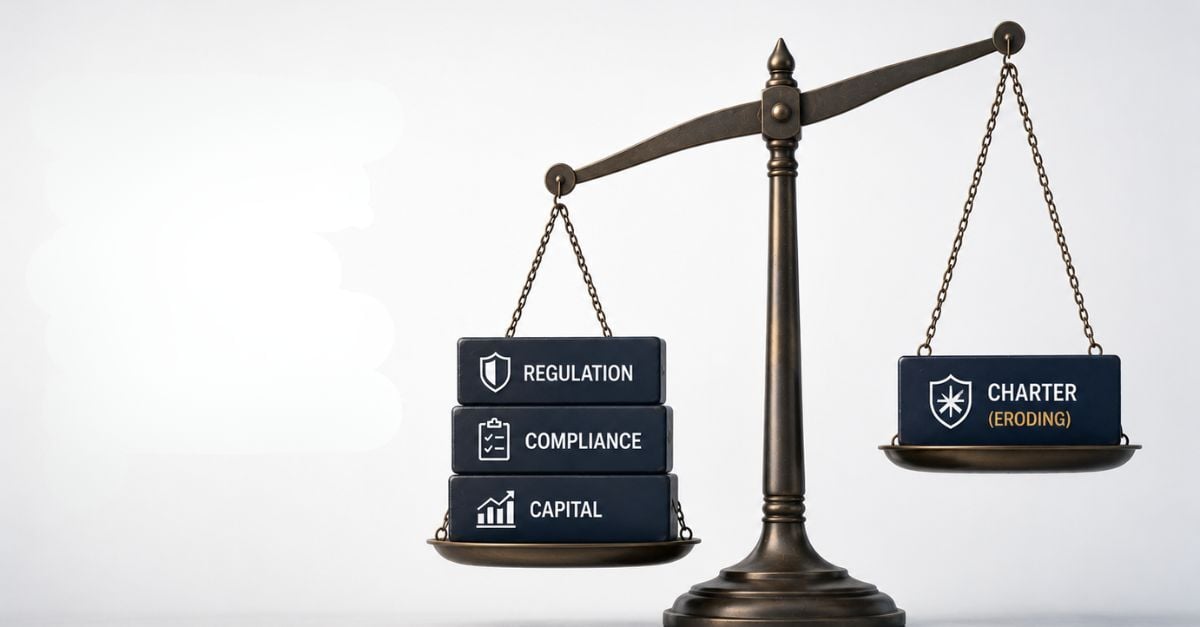
QED and Oliver Wyman called the 2025 charter wave "an inflection point in the history of financial services." That's not hyperbole. For the first time, the regulatory environment, fintech maturity, and market conditions have aligned to make chartered banking economically viable for digital-native competitors at scale.
The implications cascade quickly. Fintechs with charters can compete for deposits without paying BaaS fees or accepting sponsor bank constraints. That improves their unit economics, which lets them offer better rates or invest more in customer experience. Better economics attract more customers, which creates more scale, which justifies more investment in technology and product development. The flywheel accelerates.
Meanwhile, community banks face the opposite dynamic. BaaS revenue disappears as partnerships internalize. Deposit competition intensifies from better-funded competitors with structural cost advantages. Technology investment requirements increase to match customer expectations set by digital-native competitors. The choice becomes stark: either build genuine relationship advantages that justify higher deposit costs, or accept operating as subscale lenders dependent on wholesale funding and rate competition.
There is no middle ground anymore. The regulatory arbitrage that made BaaS partnerships attractive to fintechs is collapsing as fintechs bring capabilities in-house. The rate competition that many community banks used to retain deposits is unsustainable against competitors with 170-to-187-basis-point advantages and no branch infrastructure costs.
What makes this an inflection point rather than just another competitive challenge is the permanence. Once Mercury operates as a bank, it's not going back to being a sponsor bank customer. Once PayPal has an ILC charter, it's not renewing partnership agreements. Once SoFi demonstrates that scaled fintech banking generates superior returns, every other fintech at scale runs the same analysis. The direction is one-way.
Community banks spent the last decade telling themselves that fintech partnerships were win-win collaborations. Fintechs get regulatory access, community banks get fee income and growth, customers get better digital experiences. Everyone wins. Except that narrative required fintechs to permanently accept higher costs and limited control in exchange for convenience. And the moment fintechs reached sufficient scale to justify charters, the collaboration ended.
The uncomfortable truth: the partnership was always temporary from the fintech perspective. Community banks that built strategy around permanent BaaS relationships misunderstood the economics. Fintechs were never going to pay forever for something they could build themselves once they reached scale.
And now they've reached scale.
The Questions Your Board Should Be Asking
The charter wave isn't hypothetical future disruption. Mercury applied in December. PayPal applied in December. Erebor received conditional approval in October and deposit insurance approval in December. These institutions will be operating as banks in 2026 and 2027, competing directly for deposits and lending relationships that community banks currently count as core business.
So here are the questions that should dominate your strategic planning sessions.
On deposit strategy: Can you articulate why a customer should keep deposits with you that pay 200 basis points less than a newly-chartered fintech offers? Is that reason based on genuine relationship value that you're actively delivering, or on inertia that evaporates the moment the customer downloads a competing app?
On fintech partnerships: If you're generating revenue from BaaS relationships, what's the realistic duration of those contracts given that your partners are watching Mercury, SoFi, and PayPal bring banking in-house? What's your plan when that revenue stream disappears? "We'll find new fintech partners" isn't a plan when the mature, scaled fintechs are all pursuing charters.
On competitive positioning: Mercury describes itself as serving "ambitious companies and individuals" with "radically different banking." What would your marketing say? If you can't articulate a compelling differentiation that justifies premium pricing or lower deposit rates, you don't have a competitive position. You have market share that's available to anyone willing to compete on price.
On relationship advantages: If you've invested significantly in relationship management, industry expertise, and differentiated service, can you measure the customer retention and pricing premium that investment generates? If you can't measure it, how do you know it's working?
On scale: The fixed costs of regulatory compliance, technology infrastructure, and talent acquisition are rising. QED and Oliver Wyman note there are 4,500 banks in the United States, many of which remain subscale, slow in adopting digital, and tied to outdated branch infrastructures. Which category are you in? And if you're subscale, what's the path to either achieving scale or building such strong relationship advantages that scale becomes less critical?
On the next five years: If fintechs are reaching the top 50 by assets by 2028 to 2030, as QED projects, which banks are they displacing? It's not going to be JPMorgan Chase. It's not going to be Bank of America. It's going to be regionals and large community banks that competed on price rather than relationships, that depended on BaaS revenue, that assumed customer inertia was loyalty.
The Window Is Narrow
Comptroller Gould called the 2025 charter application surge a "return to the norm" after years of regulatory discouragement. He's right, but the new normal isn't the old normal. The banks being chartered in 2025 are digital-native, venture-backed, and built for scale. They're not competing for the same customers legacy banks served in 1995. They're competing for the customers legacy banks are trying to serve in 2026 with aging infrastructure and digital capabilities that lag customer expectations.
Community banks have a window (probably 12 to 24 months) to make the strategic choices that determine whether they thrive, survive, or get acquired. That window requires assessment of whether current competitive positioning is defensible against better-funded, lower-cost competitors with superior digital experiences.
The good news: genuine relationship banking still works. Customers still value trust, local market expertise, and personalized service that solves real problems. Small business owners still want bankers who understand their industries and can make credit decisions based on relationship knowledge rather than algorithm scores. Commercial borrowers still value responsiveness and flexibility. But those aren't defaults. They're built through intentional strategy, consistent execution, significant investment, and willingness to walk away from rate competition that erodes profitability.
The bad news: pretending the fintech charter wave doesn't affect you because "we're different" is the fastest path to irrelevance. Twenty applications in 2025. More coming in 2026 as other scaled fintechs run the same cost-benefit analysis that Mercury and PayPal ran. Each one represents a competitor that used to need you and has decided it doesn't anymore.
Some community banks will point to their stable deposit base, their loyal customers, their local market knowledge. They'll note that fintechs have been "disrupting banking" for a decade and community banks are still here. They'll insist their situation is different. But in 36 months, the banks that haven't adapted will be explaining to shareholders why net interest margin compressed, why deposit growth stalled, why BaaS revenue disappeared, and why the strategic plan didn't account for competitors with 170-to-187-basis-point cost-of-funds advantages operating at scale.
The only question left is what you're going to do about it. The charter applications are filed. The approvals are being granted. The fintechs are becoming banks. The clock is running.
And unlike the last decade of fintech "disruption," this time they're not asking permission. They're not seeking partnerships. They're not renting your infrastructure.
They're replacing it.
 Virginia Heyburn : 6/5/26, 2:45 PM
Regulatory changes are reshaping the banking landscape, challenging community banks to adapt their strategies amid rising fintech competition.

 Joe Dugan : 5/21/26, 2:00 PM
Discover how Oregon's new charter initiative signals a need for banks designed to meet modern community needs, not just replicate the past.

 Fabio Biasella : 11/25/25, 8:30 AM
Revolutionizing banking with digital universal bankers using instant rails for real-time transactions, governed automation, and data-driven insights...