1 min read
Mortgage Rate Movement and Retail Bank Strategy: When 6.35% Looks Like Opportunity
Key Takeaways From This Blog: Mortgage rates still matter, but they’re no longer the primary force shaping the market. The real catalyst is ...
Navigate this high stakes process with precision.
A solution delivering fast, efficient, and accurate core data.
Digital solutions to grow, scale, and outperform.
Reliable, efficient, and integrated core platforms deliver results.
Select modern communications channels to integrate with core and digital solutions.
Strategic Planning
Support services for the strategic planning process at every level.
M&A Planning
Realize the key value drivers resulting from your merger or acquisition.
Performance Benchmarking
Tailored metrics and benchmarks designed to assess relationships.
Organizational Efficiency
Enhance efficiency across branches, digital channels, and contact centers.
A digital library of industry news, analysis, best practices, and thought leadership tailored to the challenges and opportunities faced by financial institutions.
Our in-depth analysis of conversion strategies, M&A activity, and the evolving landscape of financial services.
A podcast channel for the time-constrained banking professional delivering sharp insights on fintech, strategy, and leadership to help you stay ahead in a fast-changing financial world.
For 360fi Workflow clients only. Sign in to access the workflow library and other guides, forms, and tutorials.
8 min read
James White
:
2/5/26 6:23 PM
By 2028, between 500 and 800 U.S. financial institutions will disappear. Not from failure. From the merger.
The question isn't whether consolidation accelerates. The question is which institutions see it coming and which get blindsided.
Engage fi analyzed every bank and credit union in America using five years of financial data to identify which institutions show the stress patterns that appear 18 to 36 months before merger announcements. The result: a watch list of 865 institutions (nearly 10% of the industry) where boards will soon face a strategic choice they didn't see coming.
Here's what separates institutions that merge from strength versus necessity, and why the next 24 months determine which path your institution takes.
The Numbers That Should Wake You Up
We analyzed 8,837 financial institutions: 4,417 credit unions and 4,420 banks. Of these, 865 institutions score high enough on our merger probability model to land on the watch list.
That breaks down to 651 credit unions (14.7% of all credit unions) and 214 banks (4.8% of all banks). The gap between those percentages isn't measurement error. It's a structural reality. Credit unions face more acute consolidation pressure than banks. The typical credit union shows a 25% probability of merging within three years. The typical bank shows just 10%.
The infrastructure costs of modern financial services hit smaller institutions hardest, and credit unions skew smaller. More than half hold less than $100 million in assets, below the threshold where most institutions can sustainably support competitive technology while building capital.
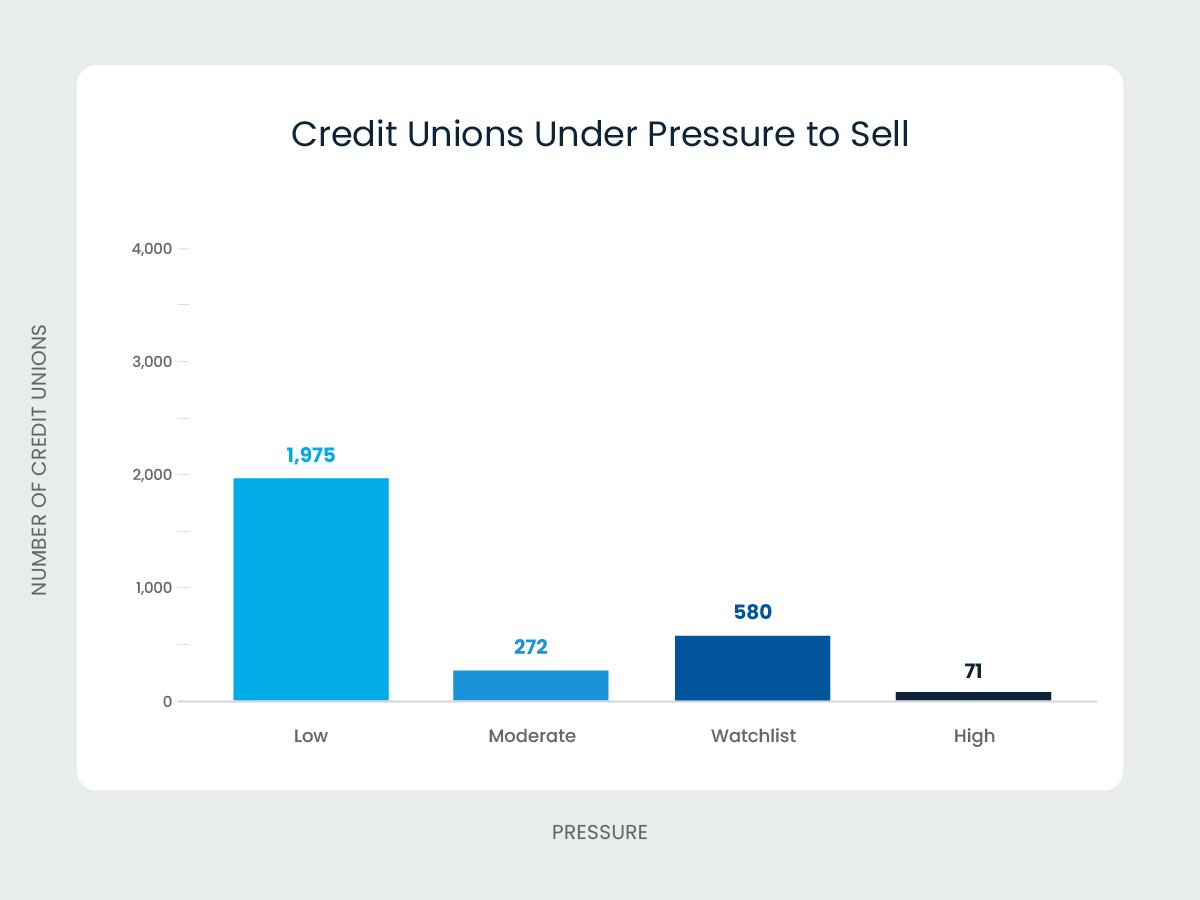
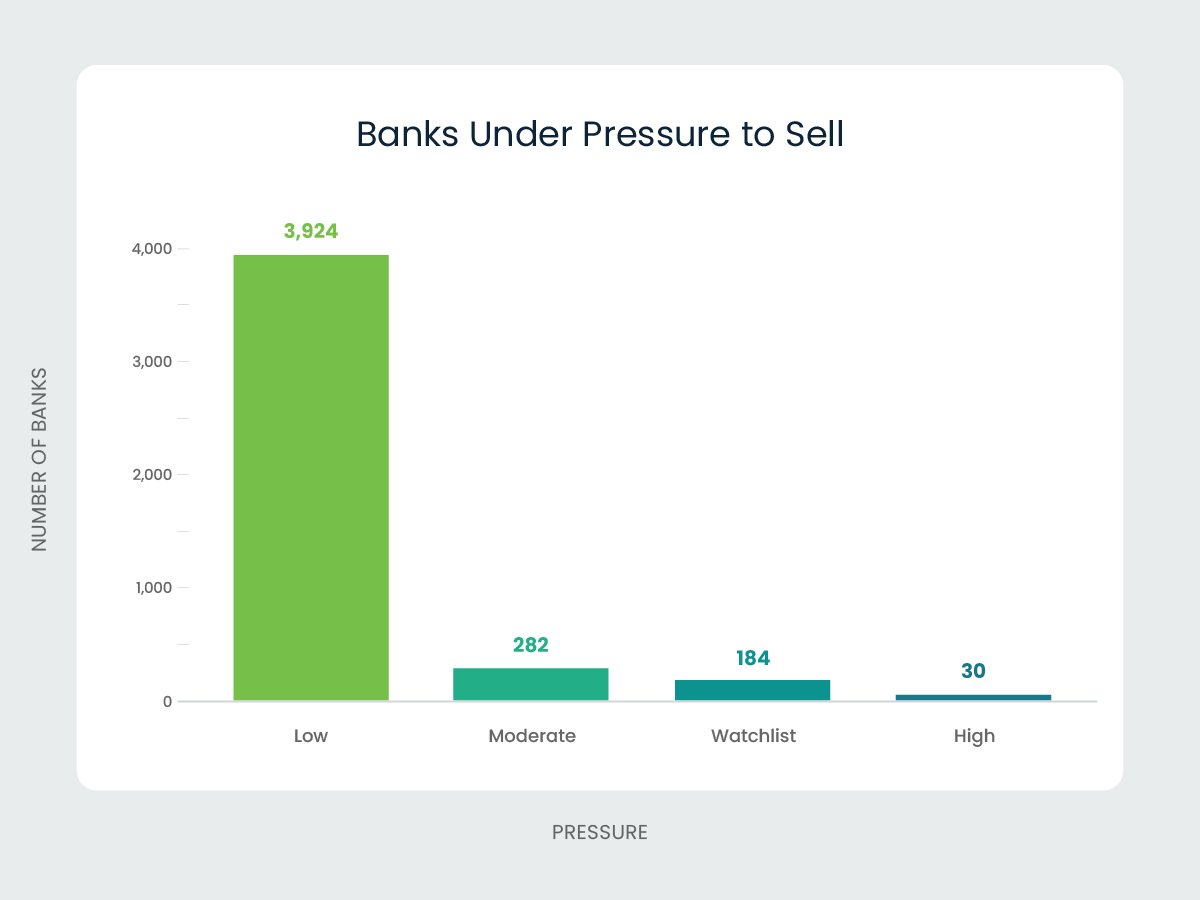
Within our watch list, 101 institutions (71 credit unions and 30 banks) show a merger probability above 85%. These aren't maybes. These are institutions where the financial stress signals flash red across multiple quarters and multiple metrics.
The remaining 764 watch-list institutions (580 credit unions and 184 banks) have a probability score between 60% and 85%. This tier matters more because these institutions aren't in crisis. They'rein the zone where strategic alternatives start looking attractive. Boards begin asking whether investing millions in technology upgrades makes economic sense compared with partnering with an institution that has already made those investments.
What We Actually Measured (And Why It Predicts Mergers)
Traditional M&A predictions wait for announcements. We tracked the warning signs that surfaced 18 to 36 months earlier.
Our model evaluates institutions across 12 financial patterns, comparing each against similar-sized competitors over five years. The patterns fall into three categories that boards recognize immediately:
Profitability problems. Institutions that consistently earn less than half a percent on their assets, quarter after quarter. That's not a bad quarter. That's a broken business model. This pattern appears in 100% of the banks most likely to merge.
Growth problems. Deposit loss, member loss, and loan growth that can't keep pace with peers. An institution losing deposits while competitors gain them isn't having a tough year. It's losing the franchise. Credit unions losing members face an existential question: if people are leaving the cooperative, what's the point of remaining independent?
Efficiency problems. Operating expenses are consuming 75% or more of revenue. High costs relative to revenue signal that the institution lacks the scale to spread infrastructure expenses across enough customers. That's fixable through a merger. It's much harder to fix independently.
We also tracked trend indicators: institutions where performance gaps relative to peers widen over time. An institution with acceptable profitability today but declining profitability relative to competitors for three straight years is falling behind competitively. By the time boards notice, they're already 18 months into the problem.
The model assigns points based on how frequently these stress signals occur and their severity. Add up the points, convert to probability, and you get a merger likelihood score from 0% to 100%.
We validated the model against actual 2025 mergers. Of 74 credit union mergers we tracked, the model correctly identified stress signals in the acquired institutions months before public announcements. The patterns are real, they're predictive, and they give boards a 24-month head start on strategic decisions.
When Multiple Problems Compound
The 101 institutions scoring 85% or above exhibit multiple, overlapping problems.
Among high-risk credit unions, the typical institution holds just $33 million in assets. Three-quarters hold less than $373 million. The smallest operates with only $300,000 in assets. Size alone doesn't doom institutions, but small size without strong performance creates mathematical challenges that boards can't ignore.
Performance deteriorates across multiple metrics simultaneously. Net worth ratios decline. Returns weaken. Efficiency worsens. Margins compress. Funding costs rise. When everything moves in the wrong direction at once, that's not temporary headwinds. That's a structural disadvantage.
Members or customers leave persistently. Credit unions losing members quarter after quarter aren't just shrinking deposits. They're losing the cooperative membership base that justifies their existence. Banks losing deposits in a growing economy face similar existential questions about franchise value.
Peer comparisons worsen. When your profitability, efficiency, capital ratios, and margins all fall below those of similar-sized competitors, the performance gap becomes a board-level strategic question: Why are we underperforming institutions like us? And what would it take to close that gap?
High-risk banks show similar patterns. The typical high-risk bank holds $80 million in assets, with three-quarters below $130 million. Low profitability is evident in every single one. High efficiency ratios appear in nearly all. Persistent deposit loss shows up repeatedly. These aren't institutions with one fixable problem. They're institutions where fixing the problems would require capital investment exceeding what the franchise can justify.

Where Boards Start Asking the Strategic Question
The watch list tier (60% to 84.9% probability) is most important for understanding the industry's trajectory because these 764 institutions aren't in crisis. They're facing economic conditions that make independence more expensive than partnership.
Here's the reality: A $200 million credit union evaluating technology upgrades confronts real numbers. New core system: $5 million. Digital banking platform: $2 million. Annual cybersecurity enhancement: $1 million. Total investment: $8 million, or 4% of assets. Over three years, that's $2.7 million annually allocated to technology rather than member benefits or reserve building.
Compare that to a merger. Partner with a $2 billion institution that's already made those investments and spreads the cost across ten times the asset base. The annual technology cost per asset dollar drops from 1.35% to 0.14%.
The strategic question is: do we have unique capabilities that justify independent operation, or do we have a strong regional franchise that is more valuable within a larger organization?
Watch list institutions show three consistent patterns:
Deposits decline year over year. In an economy where most banks and credit unions grow deposits, persistent shrinkage signals franchise erosion.
Performance metrics lag peers on profitability, efficiency, capital strength, margins, and funding costs. Falling behind on one metric might be fixable. Falling behind on all of them simultaneously suggests competitive positioning challenges that investment alone won't solve.
Trends worsen over time. The performance gap versus peers widens, not narrows. Institutions work harder to fall further behind.
Some will invest their way back to competitive performance. Some will find niche strategies that work at smaller scale. But many will look at the numbers and conclude that the merger preserves member or customer value better than struggling to maintain technology parity independently.
Who's Positioned to Acquire
While 865 institutions face seller pressure, 1,736 qualify as buyer candidates based on size and financial strength.
For credit unions, buyer candidacy requires $250 million or more in assets and a merger probability below 25%. We identified 806 credit unions meeting those thresholds. Within that pool, 81 institutions score in the top tier on buyer readiness, our measure of acquisition capacity.
Top buyer-ready credit unions combine scale (median assets of $810 million) with performance (profitability near 0.59%, efficiency ratios around 71%, strong capital cushions above 10%). They generate profits, manage expenses efficiently, and maintain regulatory buffers. That combination funds acquisition premiums and integration costs.
For banks, buyer candidacy requires $1 billion or more in assets and a probability of merger below 25%. We identified 930 candidates, with 93 scoring in the top tier. Top buyer-ready banks show median assets of $2.23 billion and strong metrics: profitability around 1.21%, efficiency near 60%, net interest margins above 3%, and robust deposit growth.
We identified 47 "retail-style" buyers among banks: institutions with 10 or more branches positioned for geographic expansion. These institutions seek market presence, not just balance sheet growth.
What the Numbers Reveal About Negotiations
The ratio of buyer candidates to potential sellers reveals market dynamics that affect merger negotiations.
For credit unions, 806 buyer candidates face 651 potential sellers (1.24 to 1). The market shows relative balance. Merger negotiations happen from positions of comparable strategic need. Buyers seek growth and scale. Sellers seek sustainability and continued member service.

For banks, 930 buyer candidates face 214 potential sellers (4.35 to 1). Buyer abundance gives sellers negotiating leverage. With more than four potential acquirers for every stressed bank, sellers can hold out for attractive offers rather than accepting survival deals. This supports merger premiums and explains why some challenged banks wait for the right partner.

Not all buyer candidates pursue acquisitions. Some prefer organic growth. Some face regulatory constraints. Some lack management bandwidth for integration. Not all watch-listed institutions choose to merge. But the ratios determine whether sellers find partners if they seek them.
What This Means for Your Board
If your institution scores 60% to 85%, you're not facing a crisis. You're facing a choice.
The data provides 24-month advance warning, not 6-month emergency signals. Institutions that wait until merger probability exceeds 90% make decisions from necessity rather than strategy. Institutions that recognize watch-list status at 65% probability make decisions based on strength.
A 70% probability institution with strong member relationships and unique market positioning might invest in technology and talent to shift trajectory. A 75% probability institution in a saturated market might seek a merger partner whose combined scale creates value neither institution could achieve independently.
The probability score frames urgency, not inevitability. But ignoring it means decisions happen in compressed timeframes with limited options. By the time deposit contraction accelerates, talent departs, and member or customer confidence wavers, merger negotiations are driven by necessity.
Boards that recognize watch list status early have time to evaluate options: invest to improve trajectory, seek strategic partnerships that preserve independence while adding capabilities, or pursue a merger from a position where you're solving strategic puzzles rather than operational crises.
What This Means for Potential Buyers
The opportunity isn't in the high-risk tier. It's in the watch-list institutions that merger discussions begin with a strategic rationale rather than a survival imperative.
High-probability sellers (above 85%) often bring limited franchise value. They're solving problems, not pursuing opportunities. Watch-list institutions (60% to 84.9%) often offer valuable member or customer relationships, talented staff, and market presence. They're choosing partnership, not escaping failure.
Due diligence should focus on the factors that drive the merger probability score. An institution stressed by margin compression but with strong deposit growth faces different integration challenges than one stressed by persistent deposit contraction. An institution with efficiency challenges but strong member loyalty offers different value than one with deteriorating performance across all dimensions.
The 174 likely buyers we identified (81 credit unions, 93 banks) have the balance sheet strength to pursue acquisitions. But acquisition success requires integration capability, cultural alignment assessment, and strategic clarity about why the combination creates value.
What This Means for the Industry
By 2028, we're projecting 500 to 800 fewer institutions. This isn't consolidation driven by regulatory pressure. It's consolidation driven by economic reality.
The infrastructure costs of modern financial services exceed what institutions below certain size thresholds can sustainably support while maintaining competitive value and building capital. That's not a policy problem. It's a math problem.
Our 865 watch list institutions won't all merge. But if 60% to 70% do over the next three to four years, that's 520 to 605 mergers, or 130 to 151 annually. Current merger velocity runs 150 to 200 credit union mergers and 200 to 250 bank mergers per year. Our projection suggests continuation of current trends, not dramatic acceleration.
The consolidation ahead isn't a crisis. It's an adjustment. The industry is moving from 8,837 institutions today to perhaps 8,000 to 8,300 by 2028. Membership and customer relationships don't disappear. They concentrate in institutions with the scale to deliver modern financial services economically.
The 24-Month Window
The institutions that will disappear by 2028 won't fail. They'll merge. The difference between a strategic merger from a position of strength and a necessity merger from a position of weakness is whether you see the inflection point 24 months ahead or 6 months too late.
What institutions do with that advantage determines whether consolidation feels like strategic evolution or forced adaptation.
Our analysis identified 865 institutions that should have board-level strategic conversations about the next three years. Some will invest their way back to competitive performance. Some will find niche strategies that work at smaller scale. But many will merge.
Those that merge from strength, with time to evaluate partners and structure transactions thoughtfully, will better serve their members, customers, and communities than those that wait until time runs out.
The M&A map is drawn. The question is whether your institution is reading it.
About the Analysis
Engage fi's M&A Probability Model analyzes 12 financial patterns across five years of quarterly data, comparing each institution against similar-sized competitors. We evaluated all 4,417 federally insured credit unions and 4,420 FDIC-insured banks using data through Q3 2024.
The model measures how often institutions exhibit stress signals (such as profitability below 0.50%, efficiency ratios above 75%, or persistent deposit losses) and how severe those signals are. Institutions showing stress signals in 15 of the last 20 quarters score higher than institutions hitting those thresholds in just 5 of 20 quarters. Persistence indicates structural challenges versus temporary problems.
We validated the model against announced 2025 mergers, matching 74 credit union mergers to our dataset. The model correctly identified elevated stress in acquired institutions months before public announcements.
For more information about Engage fi's M&A advisory services or institution-specific analysis, contact us.
1 min read
Key Takeaways From This Blog: Mortgage rates still matter, but they’re no longer the primary force shaping the market. The real catalyst is ...
The banking industry is experiencing a shift in how its customers conduct their financial business. When the last of the Baby Boomer generation makes...
Key Takeaways From This Blog: The Universal Banker is evolving into a digital, real-time advisor powered by AI, instant payment rails, and...