Speed, Proof, Trust: The 2025 Banking Playbook Hurtles into 2026
Discover how leading banks are embracing AI, real-time payments, and relationship-focused engagement to drive growth and resilience in the...
Navigate this high stakes process with precision.
A solution delivering fast, efficient, and accurate core data.
Digital solutions to grow, scale, and outperform.
Reliable, efficient, and integrated core platforms deliver results.
Select modern communications channels to integrate with core and digital solutions.
Strategic Planning
Support services for the strategic planning process at every level.
M&A Planning
Realize the key value drivers resulting from your merger or acquisition.
Performance Benchmarking
Tailored metrics and benchmarks designed to assess relationships.
Organizational Efficiency
Enhance efficiency across branches, digital channels, and contact centers.
A digital library of industry news, analysis, best practices, and thought leadership tailored to the challenges and opportunities faced by financial institutions.
Our in-depth analysis of conversion strategies, M&A activity, and the evolving landscape of financial services.
Explore our webinars, insights, videos, and upcoming events for financial institutions.
Stay up to date with the latest news and announcements from Engage fi.
For 360fi Workflow clients only. Sign in to access the workflow library and other guides, forms, and tutorials.
3 min read
Fabio Biasella
:
Published
Key Takeaways from This Blog:
Greetings from the road! As the fall planning season for banks and credit unions moves into high gear, I am, unsurprisingly, having robust discussions on AI strategy with just about every leadership group. Among the typical ideation around potential “use cases” and strategy development, an interesting discussion thread is emerging: Is there a new opportunity to leverage our position of “trust” in the age of “AI everything”?
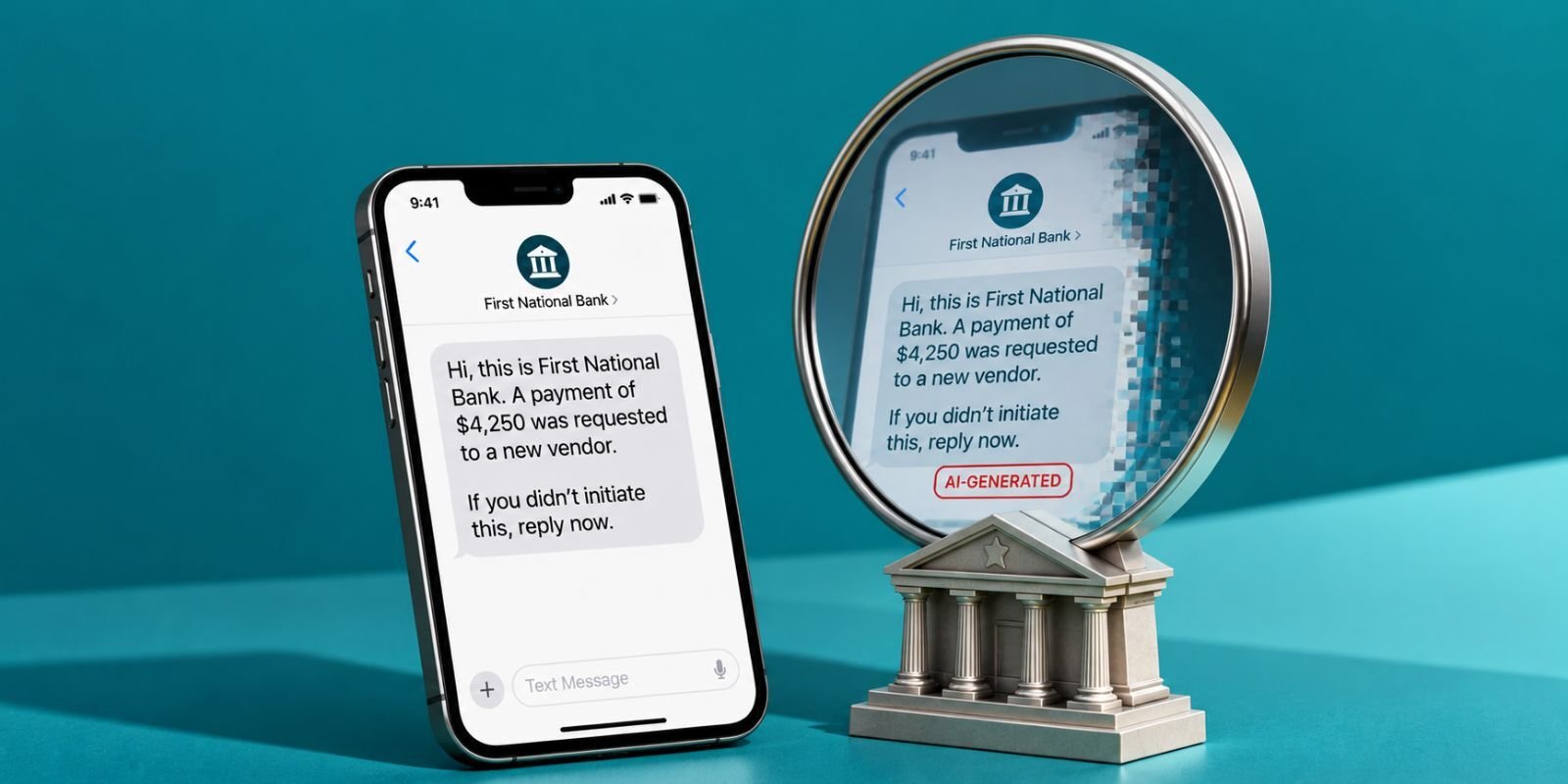
As AI breaks consumers’ ability to rely on the “seeing is believing” and “hearing is believing” framework in financial transactions and scam avoidance, the question becomes simple and urgent: Where does a consumer go to know what is real? And how can financial institutions fulfill that verification role?
That is where banking gets interesting.
Fraud Has Changed
Traditional fraud prevention was built around one question: Is this really the consumer? And we developed all the known security measures: passwords, devices, location, multifactor authentication, and biometrics. They still matter, but they do not solve the whole problem anymore.
An individual can be on her own phone. She can log into her own banking app. She can pass every authentication step. She can press send herself. And the transaction can still be fraud.
Why? Because the criminal did not break into the account. He broke into the consumer’s confidence through an ever-improving ability to deepfake.
Authentication tells us who is making the transaction. Verification now has to ask why the transaction is happening and whether the story behind it is real.
The Consumer Is Already Unsure
Consumers are changing their behavior:
They do not answer calls.
They distrust texts.
They pause before clicking links.
They question fraud alerts, even legitimate ones.
That creates a strange problem for financial institutions.
As fake messages become more believable, real messages become less believable and legitimate communication becomes harder. That is not only a fraud issue. It is an experience issue.
The FI as the Verification Layer
Imagine the banking app becoming more than a place where money moves. It becomes the place to go when doubt shows up.
An individual gets a call claiming to be from the Financial Institution. Instead of guessing, she opens the app and sees a simple answer: Yes, we are trying to reach you. Or no, we are not.
A small business owner receives new payment instructions from a vendor. Instead of trusting the email, the business uses a secure workflow to confirm the change before releasing funds.
A consumer receives a suspicious text. He forwards it into the FI’s secure environment. AI reviews it. A human can step in when the risk is high.
That changes the relationship. The institution is no longer only protecting money after something goes wrong. It is helping the individual make a safer decision before money moves.
Trust Becomes a Product
Banks and credit unions love to say people trust them. While that is true, trust is often treated like a slogan, something placed in an ad with a smiling family and a sunrise. AI changes that.
Trust can become functionality. That is the opportunity I see teams starting to explore in their discussions. Community banks and credit unions still have something valuable: institutional trust tied to human accountability.
A secure inbox is trust.
A verified callback is trust.
A contextual scam warning is trust.
A validated identity is trust.
Fast human escalation is trust.
A verified digital credential is trust.
In an AI-driven world, this will matter more than ever.
Redesign Around Doubt
Most digital banking experiences assume the consumer knows what is legitimate. The next version should assume that sometimes they will not.
That means every legitimate outbound message should be verifiable inside digital banking. Scam warnings should not be generic banners. They should appear when the behavior, transaction type, or destination suggests risk.
It means consumers should have a simple way to check a suspicious payment request, phone call, email, or text. It means AI should help triage doubt, not trap anxious consumers inside a chatbot.
And it means education should arrive at the moment of risk. Nobody reads the annual fraud awareness email. Guidance matters more when the individual is about to send eight thousand dollars to a so-called safe account.
Bottom Line
For centuries, financial institutions protected money from unknown actors physically and drew their trust from that physical and oftentimes imposing presence. Now, consumers will need help knowing which voice is real, which message is legitimate, which payment request can be trusted, which digital agent has permission to act, and which interaction deserves skepticism.
AI is making authenticity scarcer. As that happens, verification becomes more valuable.
Thus, the next killer feature in banking may not move money faster. It may simply tell the individual whether the person asking for it is real.
To dive deeper into the payments network and why it should remain a top priority, click HERE.
Discover how leading banks are embracing AI, real-time payments, and relationship-focused engagement to drive growth and resilience in the...
Understanding Millennials' and Gen Z's banking preferences is essential for financial institutions to bridge traditional and digital banking,...

Discover how community banks and credit unions can transform branches into trust centers, enhancing financial literacy and fraud prevention to serve...