Skip to the main content.

6 min read

What to Tell Your Board About the Repricing of Your Charter

What to Tell Your Board About the Repricing of Your Charter

Key Takeaways from This Blog:

  • Regulators are opening limited Fed payment rail access to some non-bank fintechs, weakening a key advantage of the traditional bank charter.
  • Community banks may face higher compliance costs while fintechs gain similar payment capabilities with fewer regulatory burdens.
  • Banks should focus on differentiated strengths like relationship lending and specialization rather than infrastructure exclusivity.

On May 19, President Trump signed an executive order titled Integrating Financial Technology Innovation Into Regulatory Frameworks, directing federal regulators to identify rules limiting fintech innovation and asking the Federal Reserve Board to deliver a report on extending direct access to Fed payment accounts for non-bank firms.

The next day, the Fed Board released its own proposal for public comment on a new "payment account" structure for institutions focused on payments innovation. The work was already underway, but the timing alongside the executive order is significant. Both actions land less than a year after the GENIUS Act became law in July 2025 — legislation that explicitly preserved existing Fed master account policy, expanding access through regulatory interpretation and product design rather than new congressional authorization.

Most coverage treats this as another fintech-versus-bank story. It is something larger. What is happening underneath the headlines is the unbundling and repricing of the bank charter itself.

Momentum is building toward 'skinny' payment accounts

Master accounts at the Federal Reserve allow direct settlement through Fedwire and access to Fed services without going through a correspondent institution. Historically, that access has been limited to chartered depository institutions.

That foundation cracked in March 2026, when the Kansas City Fed approved a "limited purpose account" for Kraken Financial, the first crypto firm to access the Fed's core payment infrastructure. Kraken came in through its Wyoming Special Purpose Depository Institution charter. The account is a one-year pilot with no interest on reserves, no discount window access, no intraday credit, and an end-of-day balance limit. The "limited purpose account" label has no statutory basis in either the Federal Reserve Act or the Board's own Account Access Guidelines. The Kansas City Fed essentially invented a tier of access to fit Kraken's profile.

The Fed Board's proposal formalizes what Kansas City improvised. These "skinny" payment accounts, as the industry has begun calling them, would be capped at the lesser of $500 million or 10% of the holder's total assets in overnight balances, restricted to clearing and settlement only, and subject to automatic rejection of any overdrafting transaction. The proposal does not expand who is legally eligible. It creates a restricted product for institutions already meeting statutory criteria. But restricting the terms of access is still legitimization. Establishing limits establishes the category. A future board could loosen or tigthen those terms. The EO also asks whether the 12 regional Reserve Banks can act independently of the Board to grant payment accounts — a question that, if answered affirmatively, would make Kansas City's Kraken approval a template rather than an exception.

The unbundling of banking's protected privileges

For most of the last century, the bank charter has functioned as a bundle of protected privileges: FDIC insurance, Fed payment rail access, and deposit-taking authority. Everything else community banks sell — relationships, local lending, community knowledge — has been built on top of that protected infrastructure.

A fintech using a Wyoming SPDI or an OCC trust charter could then realistically aim for a Fed payment account, settle through Fedwire, and partner with an insured bank for the deposit layer. FDIC insurance, the discount window, interest on reserves, trust powers, and the deposit franchise remain bank-only. But the rails, historically the most operationally valuable exclusivity, are being opened.

The unbundling isn't being done by Silicon Valley. It's being done with federal authorization. Your competition isn't being built in a garage. It's being authorized by your regulators, one charter at a time.

Fintech competition gets the moat without the cost

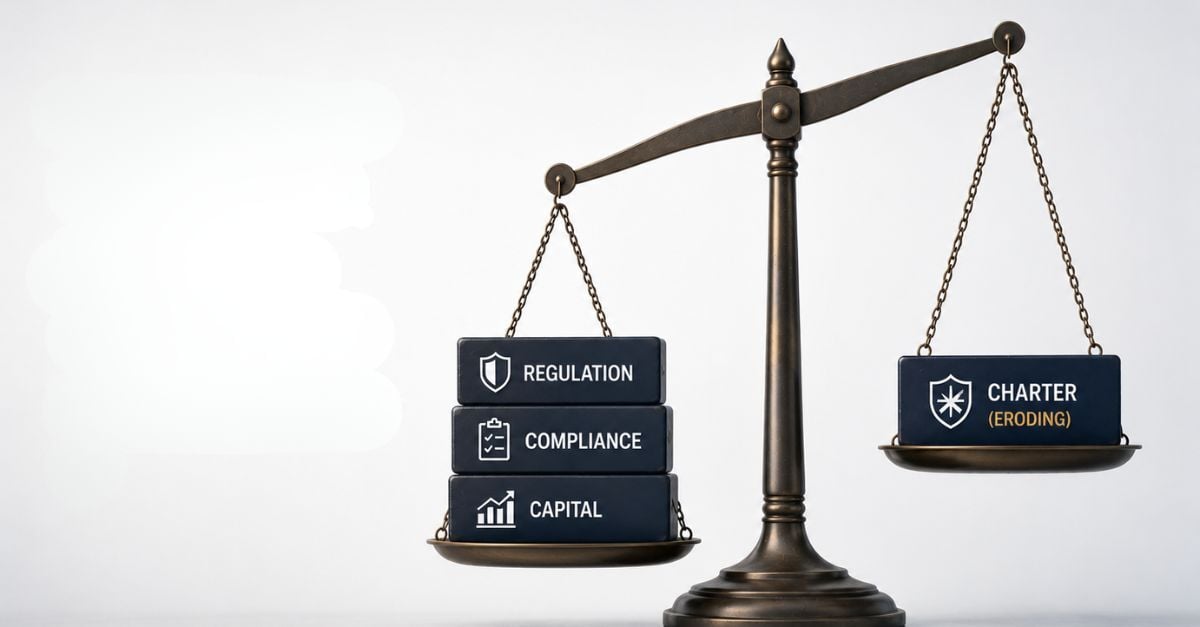
When the charter's exclusivity erodes, what did your community bank actually buy when it accepted a century of regulatory burden? CRA exams. BSA programs. Capital and liquidity requirements. Fair lending oversight. Consumer compliance. The burden was implicitly priced against the exclusivity.

If the privilege is being commoditized but the burden isn't, community banks end up holding the most expensive end of the stick. They pay bank-grade compliance costs to compete with companies that have bank-grade access without bank-grade obligations.

For most of banking history, regulatory burden was the cost of a moat. It now risks becoming a handicap against competitors who got the moat without the cost.

ICBA put it precisely in its May 19 response: "Policymakers must recognize the significant gaps in regulation, supervision, and resolution between banks and nonbanks and ensure like activities are subject to like regulation." The trade association is calling for a coordinated pause on stablecoin, master account, and OCC trust charter policies, and insisting that any fintech granted a master account be required to pay for federal deposit insurance. The principle is now on the record, and the specific policy demands are sharpening. What hasn't yet happened is connecting all of this to what regulators are actually repricing: the exclusivity bundle that justified the burden in the first place.

Three competitive dynamics will shape what comes next.

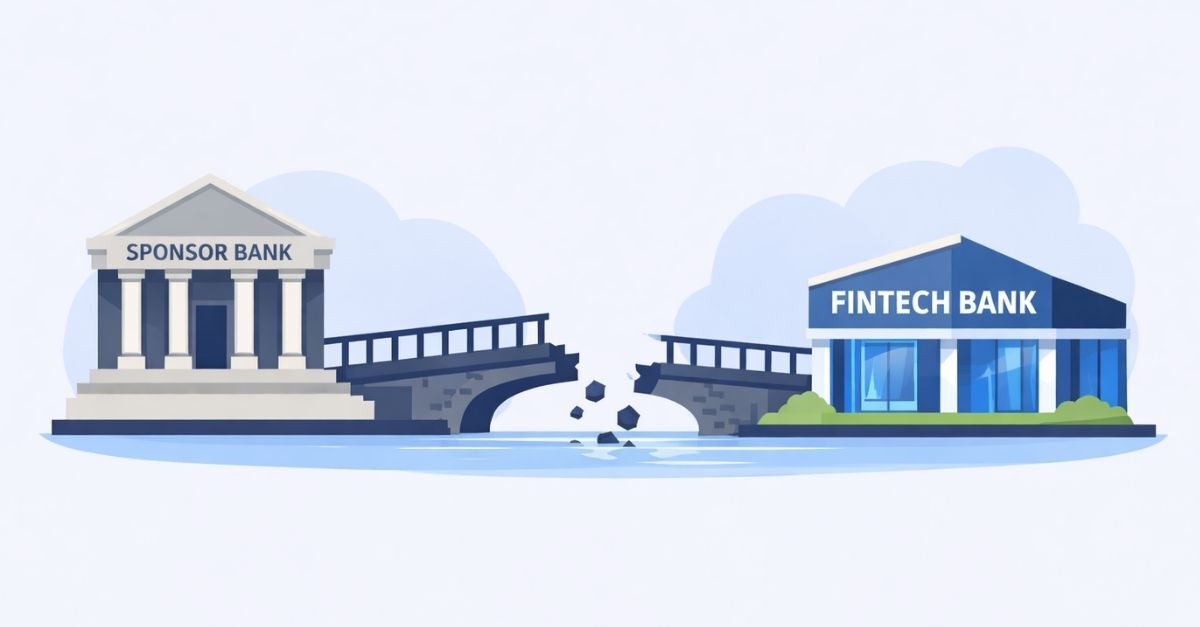
Fintechs have a window. The smart fintech read is not that the master account is coming. It is that the master account is coming with restrictions, and the firms that already have charter substitutes will be positioned to maximize them. Expect a faster race for Wyoming SPDI, OCC trust, and industrial loan company charters before regulatory backlash narrows those paths. High-volume payment fintechs and stablecoin issuers will be the first wave of payment account applicants. They will not abandon bank partnerships entirely; they will keep one or two for the FDIC and lending capabilities they cannot replicate.

Community banks face a squeeze on both sides. The BaaS revenue from being the rails intermediary erodes as fintechs gain direct settlement access. The regulatory burden that justified that intermediary role stays in place. Meanwhile, big banks have a tailwind that will accelerate consolidation, with scale and full Fed services insulating them from the same dynamics. The obvious moves, like fighting the Executive Order, defending undifferentiated BaaS revenue, or partnering harder, are all losing strategies. The winning play requires accepting that the infrastructure layer is being commoditized and pivoting hard to the layer that is not — judgment-based lending, relationship banking, and the insured deposit franchise.

Technology vendors making very different bets. The core banking providers face a choice they have not had to make explicitly before: serve fintechs as first-class customers on equal footing with banks, or preserve bank-first positioning and risk being disintermediated by infrastructure-native players. BaaS orchestration vendors whose value proposition was primarily payment rail intermediation face the inverse problem; their value erodes if fintechs can hold Fed accounts directly. Vendors selling deposit insurance access, lending capacity, or compliance infrastructure as part of their stack are more insulated. Payments and real-time settlement vendors get a tailwind from any expansion of who can settle through Fed rails. Especially now, banks will be challenged to ensure alignment of their technology decisions with a shifting strategic plan.

Four discussion points for your board

Anchor the advocacy frame. "Protect us from fintechs" loses, and it should lose. "Like activities, like regulation" wins, and it is now the explicit ICBA position. Every comment letter on the Fed Board's payment account proposal, every congressional meeting, every regulator conversation needs to make the same argument: if you grant fintechs bank-like access, you have to mandate bank-like obligations, or you have to relieve community banks of obligations priced against an exclusivity that no longer exists.

File comments on the Fed Board's payment account proposal. This is the immediate, concrete policy lever. The terms being set right now — balance caps, eligibility criteria, supervisory expectations, the pause on access decisions for uninsured non-bank institutions — will define the perimeter of charter dilution for years. Community institutions that show up in this process shape the outcome.

Shrink the charter, not the institution. Stop treating every regulated activity as a defensive priority. Identify the two or three businesses where the charter genuinely creates value, like relationship-based small business lending, deposit-funded community lending, or fiduciary services in trust markets fintechs cannot reach. Concentrate capital and attention there. Consider exiting or partnering out of activities where the charter is a cost without a corresponding gated moat.

Decide what has to be inside the charter to justify keeping it. The capabilities your customers will demand from a bank in five years, like faster payments, embedded finance, and programmatic money movement, are the same capabilities fintechs with Fed payment accounts will be able to deliver natively. The question is not whether to partner. It is which capabilities have to live inside your charter to justify the cost of maintaining the charter at all.

Then the harder question: which category does this institution fall into? Banks with strong specialization, in areas like ag lending, marine finance, CDFI work, or regional verticals, will survive because they are hard to replicate. Mid-sized banks with mature BaaS programs that sell the full stack of compliance, insurance, lending, and rails together will survive on focus. Undifferentiated community banks with neither specialization nor scale are the most exposed. Boards in that exposed middle have to decide: pursue acquisitions to gain scale, double down on specialization, or position for sale to a larger acquirer while multiples are still favorable.

The rails are opening, slowly and on contained terms. Once a new access pathway exists and firms have built business models around it, revoking it creates regulatory barriers and political backlash few administrations will absorb.

A century-old bargain between regulators and chartered institutions is being rewritten. The regulatory burden community banks accepted in exchange for exclusivity needs to be rewritten with it. The institutions that come through this strongest will be the ones whose boards treat the Executive Order as the opening move in a multi-year restructuring of what a bank is.